
Using DoView Boards
(The 17 Questions They Answer)
PAGE STILL BEING BUILT
See DoViewBoards for a high-level introduction and DoViewBoardsHowTo for screenshots of how to use and this page for details of how you use a DoView Board to answer the key questions about any initiative
Quick Overview
DoView Boards are the faster, innovative way of doing (and proving you are doing) all aspects of outcomes-based planning, implementation, measurement and reporting. They can be used with organizations, strategies, policies, projects, joint ventures, collaborations, sectors and initiatives of any sort in any setting. They can be used for human organizations, human/AI collaborations and potentially for AI agents so they can report back to humans on what they are doing. This page provides details on how you can use DoView Boards.
There are 17 key questions that need to be answered for comprehensive planning, implementation, improvement and reporting on any initiative of any type and DoView Boards are the lightweight way of answering all of these.
Note that the current implementation of DoView Boards created with the prompts available on this site is a prototype. Use it to pilot and test if the approach adds value, but at the moment, maintain your other planning and implementation documentation as a backup.
Below are the 17 questions that DoView Boards allow you to quickly answer about any initiative you are running or you are wanting to have oversight of.
Challenge: Find any other lightweight app (no app install, runs in a browser window) that answers in one place these 17 questions about any initiative.
The 17 Key Questions
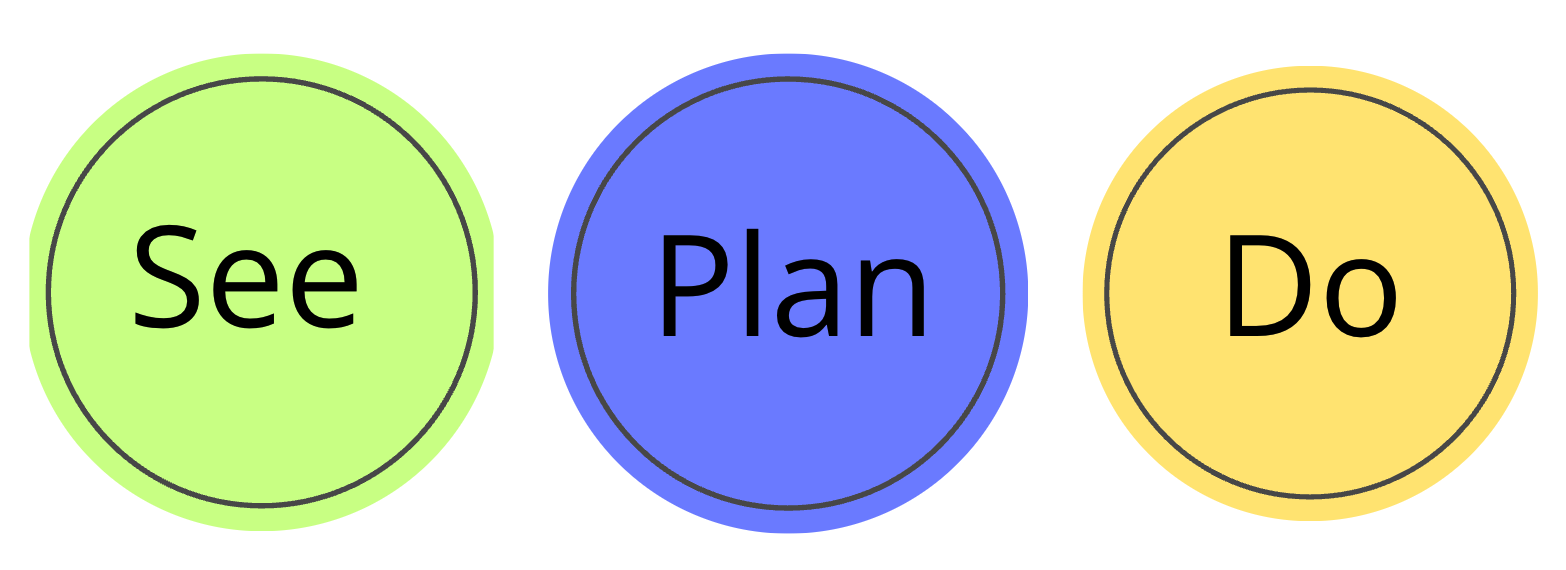
SEE:
1. What are the outcomes and steps that it is believed will lead to them?
2. What are the risks, assumptions, dependencies and constraints being faced?
3. Is there a robust logical connection connecting the proposed steps with the outcomes being sought?
4. Is what is being proposed evidence-based?
5. Which projects or activities are going to be undertaken?
6. What are other important elements needed to do the work (e.g. resources, competencies) and how do they relate to our outcomes, steps, projects or activities?
PLAN:
7. Which steps and outcomes are priorities for the next planning period?
8. How can it be proved that proposed projects or activities are tightly aligned with priorities?
9. What will be the budget allocation to different projects or activities?
10. What measures/indicators (KPIs, OKRs etc.) will be measured and which steps and outcomes will they measure?
11. What evaluation questions will be asked, and which steps and outcomes will they evaluate?
12. What is the performance measurement and/or evaluation plan for collecting performance management and evaluation information?
DO:
13. How will different parties involved in doing the work be clear about who will be doing what and how will they coordinate their activities?
14. Exactly what are the delegated or contracted accountabilities of different parties (staff, contractors, organizations etc)?
15. How can progress be shown as the work is being done?
16. How is ongoing implementation of the work going to be improved?
17. What is the best way to comprehensively report back on what is being done, its impact and results to relevant parties?
1. What are the outcomes and steps that it is believed will lead to them?
Build This-Then pages showing steps and outcomes (do this manually or put the provided prompt and engine files into ChatGPT or Claude and ask it to build them.
Use them as the basis for every discussion about what will be done.
Build a DoView Board with draft This-Then pages or get an AI system to build it. These set out the high-level outcomes being sought and the steps that it is believed need to be taken to make them happen. These draft pages should be amended and agreed to by the organization or initiative as truly representing what is being attempted. These pages in the DoView Board can then be used as the basis for every discussion with governance, management, staff, partners, contractors, stakeholders, funders etc.
Note: Put the DoView Board building prompt and engine file downloadable from this site into ChatGPT or Claude, provide it with information, or tell it to get it from the internet and to build a DoView board about any organization, collaboration, policy, strategy or other initiative of any sort.
2. What are the risks, assumptions, dependencies and constraints being faced?
Incude risks, assumptions, dependencies and constraints in the boxes on This-Then pages.
These will all be included in the This-Then pages of the DoView Board. The rules for drawing This-Then pages are that they should include boxes for all important risks (written in the positive) and ones for assumptions. Dependencies are shown in the relationships between boxes (discussed in 3) and constraints are, like risks, included on This-Then pages and written in the positive. Note: The idea is that the This-Then pages of a DoView Board contain in one place everything about the outcomes and the ‘strategy space’ in which they are being sought that is needed for thinking about and discussing strategy with anyone.
3. Is there a robust logical connection connecting the proposed steps with the outcomes being sought?
Put in links between This-Then boxes showing which steps it is believed will make other steps and outcomes happen.
Use these links as the basis for showing that what is going to be done is a logical approach.
Show which boxes on the DoView Board’s This-Then pages make other boxes happen by putting links between boxes. Or get AI to create a draft set of links, have these amended and agreed to by the organization or initiative as accurately reflecting initial beliefs about which boxes will make which other boxes happen in order to achieve final outcomes. Get independent experts or an independent AI system to audit whether the initial This-Then links being claimed seem to be credible or not at face value. Use the DoView Board’s This-Then pages with underlying links to prove to anyone there is a robust logic underlying the approach which is being taken by the organization or initiative. Note: People like to claim that they have a clear intervention logic or theory of change but almost no existing approach provides something similar to DoView Board’s fine-grained visual examination of the logic of all of the steps an organization or initiative thinks it needs to do to achieve its outcomes.
4. Is what is being proposed evidence-based?
Put existing evidence or a sensible rationale under This-Then box links.
Use these to show that what is being done is evidence-based.
Under the links between This-Then boxes claiming that they will make other boxes happen in the DoView Board (the claims in 3 above) put any existing evidence that supports the claim and provide a clear rationale for the link in those cases where existing evidence is not yet available. Or get AI to populate the DoView Board with the draft evidence or rationale under This-Then links that can then be amended and agreed to by the organization or initiative as accurately reflecting existing evidence about This-Then claimed links. Get independent experts or an independent AI system to audit whether existing evidence actually proves the links or if there is a sound rationale for the link. Use the ability to immediately drill down to the specific evidence or rationale for any This-Then link to prove to anyone that the organization or initiative is evidence-based. Note: People like to claim that they are taking an evidence-based approach, but almost no existing approach provides something as efficient as DoView Board’s ability to allow a fine-grained visual examination of the evidence or rationale behind This-Then claims.
5. Which projects or activities are going to be undertaken?
Put in a How page with boxes for the projects/activities that will be done to make the This-Then boxes happen (put hyperlinks out to the detailed planning pages within any project planning platform that is being used).
Put in more up-and-down How pages (Level 1, Level 2 etc) to show hierarchical relationships such as projects/teams/individuals/AI agents at different levels.
Link these up with up-and-down links (shown by the square counts on the top and bottom of boxes).
Get an AI system to create a How page with a box for each project (or activity if it is a DoView Board for a small-scale project). Put whatever details are needed under these project/activity boxes. If wanted, make the projects/activities page a Level 1 How page and then make a Level 2 How page. The Level 2 How page could, for instance, have boxes for each of the teams that will be working on one or more projects/activities. And if wanted, also make a Level 3 How page with team members who are in each team. Link these up-and-down pages with up-and-down links (the count shown at the top and bottom of boxes) so one can click up and down the structure. Note: There can be up-and-down hierarchical How pages in addition to other How pages that do not have any ‘level’. Note: That if the DoView Board is about a joint venture, collaboration between organizations, collaboration between humans and AI agents or just between AI agents, then the Level 2 How page can just show the different entities contributing to the different projects on the Level 1 How page. Note: If using an existing project planning platform (e.g. Microsoft Project) put hyperlinks under the project/activity pages that click out to the relevant page for each project in the project management platform.
6. What are other important elements needed to do the work (e.g. resources, competencies) and how do they relate to outcomes, steps, projects/activities
Put in any other important elements in boxes on no-level How pages.
Link them with non-up-and-down links to other relevant boxes in the DoView Board (these links exist where the square on the right-hand border of a box has a dark fill).
Use these to show how other things will support the achievement of things like projects, steps and outcomes
Get an AI system to suggest other ‘no-level’ How pages that could be included in the DoView Board (e.g. resources, competencies). Put boxes on these pages or get the AI system to populate these and just check that they are right. Make non-up-and-down links between boxes on these pages or get an AI system to put in these links and just check them. Note: The existence of such non-up-and-down links will be shown by the square on the right-hand side of any box having a dark fill.
7. Which steps and outcomes are priorities for the next planning period?
·Prioritize the boxes being focused on in the next planning period (click on the white priority box on the top left).
Use the DoView Board to discuss these priorities with anyone.
Put priorities on either, or both This-Then and How page boxes. Or get an AI system to put in draft priorities and then amend and agree to them. Use the DoView Board to discuss these priorities with whoever they need to be discussed with (e.g. governance, managers, staff, contractors, funders, auditors, stakeholders etc.).
8. How can it be proved that proposed projects or activities are tightly aligned with priorities?
Put in up-and-down links between This-Then boxes and project/activity or other boxes (click on the bottom squares of This-Then boxes or the top squares of How boxes to put these in).
Visually compare the number of up-and-down links from projects to priority This-Then boxes to make sure that there is alignment of effort with priorities.
Put in up-and-down links between This-Then boxes and How boxes such as projects/activities or get an AI system to do this and check and agree on these links. Visually check that there are an appropriate number of How (e.g. project/activity) boxes linked to priority This-Then boxes. And that there are not priority This-Then boxes without a sufficient number of projects/activities focused on them, or that there are low priority This-Then boxes with too many How boxes linked to them. Or get an AI system to do this analysis and put a red border around any This-Then box where there is not sufficient alignment of priority with effort.
Note: One can have perfect priorities and be delivering project outputs perfectly but still be wasting resources because there is not tight alignment between priorities and effort. Most people claim they are aligning their projects or activities with their priority outcomes, but without a DoView Board, they usually have no effective way of quickly proving that they have such alignment.
9. What will be the budget allocation to different projects or activities?
Put in information under each relevant How page box (e.g. project boxes) showing how much of the budget is being allocated to it (by putting this in one of the notes fields in the details window by selecting the particular box).
Use this in discussions with anyone to show where the budget is being allocated.
Use the up-and-down visual alignment between projects and This-Then steps and outcomes (8 above) to show the steps and outcomes on which the budget is being focused.
It is useful to be able to show how the budget is being allocated to How page boxes such as projects, and using visual alignment (8 above) between This-Then boxes and How boxes, to the extent possible, show budget allocations in relation to priority steps and outcomes.
Note: Because an individual How box (e.g. a project) can influence a number of This-Then steps and outcomes, it is often not possible to accurately apportion how much is being spent on each step or outcome.
10. What measures/indicators (KPIs, OKR etc.) will be measured and which steps and outcomes will they measure?
Put measures (metrics/indicators/KPIs/OKRs etc.) where these are available, under each step, outcome, How elements (e.g. projects) and link (by selecting the measures in the details window underneath any selected box).
Use this to discuss and review the extent to which the measures being used are measuring things that are important.
Measures can be inserted below many boxes on a DoView Board. An AI system can be asked to populate the DoView Board with key measures. Use the View menu for pages to make measures visible under boxes on DoView Board pages. A full list of measures is also available by clicking on the Measures item in the top bar. The same measure can be associated with more than one box in a DoView Board.
Note: Measurement should always follow strategy. There needs to be a way of articulating outcomes and steps independently of whether they are currently able to be measured or not. Because a DoView Board is designed to facilitate this, it means that one is immediately aware of what measures are actually telling you in terms of which steps and outcomes are being achieved. If you just attempt to track performance from just a list of measures, without having them mapped onto the underlying steps and outcomes you can make the serious mistake of just doing the measurable rather than the strategically important.
11. What evaluation questions will be asked, and which steps and outcomes will be evaluated?
Put evaluation questions under the steps and outcomes that they are focused on examining.
Use these to discuss exactly the level of boxes on the This-Then pages that evaluation will be focused on.
Evaluation questions can be inserted below many boxes on a DoView Board. An AI system can be asked to populate the DoView Board with key evaluation questions. Use the View menu for pages to make evaluation questions visible under boxes on DoView Board pages. A full list of evaluation questions is also available by clicking on the Evaluation Questions item in the top bar. The same evaluation question can be associated with more than one box in a DoView Board.
Note: In evaluation planning, it is often difficult to quickly understand the level at which evaluation questions are focusing. This means stakeholders can get a mistaken impression of what an evaluation will actually be able to show. In addition, sometimes in evaluation plans, the same evaluation question can be written in different ways. When using a DoView Board, always mapping evaluation questions onto the step or outcome they are focused on examining means that one can quickly identify if two differently worded evaluation questions are actually attempting to answer the same thing.
12. What is the performance measurement and/or evaluation plan for collecting performance management and evaluation information?
Write up a detailed performance management and/or evaluation plan (on its own Documentation page).
Include performance management or evaluation projects as boxes (on their own How page).
Associate these with the measures or evaluation questions they will be focused on.
Include elements from the DoView Board (page names, boxes, measures, evaluation questions) in the performance management and/or evaluation plan as clones, so if they are edited elsewhere, they will be updated in the plan (you can insert clones of DoView Board elements onto any Documentation page by selecting ‘clone’ on the editing bar)..
Write up a full performance management plan directly within your DoView Board using a Documentation page. It is a time saver to be able to clone elements (e.g. measures, evaluation plans) onto a Documentation page because it means that it is much easier to keep such documentation up to date. Create an additional How page with boxes for performance management or evaluation projects, and attach to each of these boxes the measures or evaluation questions they will be measuring.
Note: Currently organizations and initiatives have a number of different sets of documentation for strategy, performance measurement, evaluation, contracting etc. With DoView Boards all this information can be kept within the one DoView Board and by doing so the different pieces of documentation can be fully aligned with each other and be easily kept up to date.
13. How will different parties involved in doing the work be clear about who will be doing what, and how will they coordinate their activities?
Map organizations, teams or individuals onto the outcomes or steps they will be focusing on.
Use this mapping to discuss and coordinate between themselves who will be doing what.
Link organizations, teams or individuals on How pages to the outcomes or steps on This-Then pages they will be focusing on. Or get an AI system to populate a DoView Board with these and then just check them. Use visual alignment (8 above) to see if there are any gaps or overlaps in who is doing what. Use this visualization to help the parties discuss how they will coordinate their work to avoid gaps and overlaps.
14. Exactly what are the delegated or contracted accountabilities of different parties (staff, contractors, organizations etc)?
Identify which measures (with targets included) particular parties will be held accountable for.
Use these for contract documentation and attach a read-only version of the DoView Board with contracts or delegation documentation.
Link organizations, teams or individuals to outcomes or steps. Put in measures with targets and associate them with organizations or individuals as accountabilities and deliverables. Or get an AI system to populate a DoView Board with these and then just check and agree with them.
Note: Once a DoView Board is fully populated and agreed to, it serves as the ‘single source of truth’ regarding the organization or initiative. It can then be used with any AI system to create specific documentation. For instance, contract documents for particular providers. Also, a read-only version of the relevant DoView Board can be included with the contract to ensure providers are clear about what they are being contracted to do.
Note: Those being contracted or delegated to produce particular deliverables should also be able to quickly see how their deliverables fit into the wider picture of outcomes and the steps that are being used to achieve them.
15. How can progress be shown as the work is being done?
Traffic light the extent to which outcomes, steps and other boxes are being achieved.
Use the traffic-lit DoView to discuss progress and work out what to do next.
Traffic light how much progress is being made on steps, outcomes and other boxes in the DoView Board. Or get an AI system (e.g. from information it can find on the internet, internal documentation such as dashboards, performance management reports, evaluations etc.) to traffic light progress on boxes and check these. Use the traffic-lit DoView to discuss progress and work out what to do next.
Note: If you have traffic-lighted before you have a priority setting discussion as in 2. above the traffic lights will give you guidance as to what should be priorities going forward.
16. How is ongoing implementation of the work going to be improved?
Use the DoView Board for rich discussions regarding what progress has been made and what needs to be done to better achieve outcomes.
Have all discussions about how to improve what is being done in an organization or initiative against the DoView Board. This means that all of the information that is necessary for improvement is immediately available. If desired, show an AI system the DoView Board and ask it to make suggestions regarding what should be done to improve what is being done.
Note: People often attempt to have discussions about how to improve what is being done by relying on those involved being able to remember information from having read reports about progress, feedback and evaluation reports. They often do not remember everything that they need to remember to do this properly. In contrast, when using a DoView Board all of the relevant information is immediately available just a click away and it has been put onto the board associated with the elements on the board that it is most relevant to.
17. What is the best way to comprehensively report back on what is being done, its impact and results to relevant parties
Use the DoView Board to report back to governance, management, funders, staff and stakeholders.
If they also want reports in other formats, just get an AI system to produce such reports from the DoView Board as the ‘single source of truth’ about the organization or initiative..
Use the DoView Board as the basis for any discussion with anyone about anything related to the organization or initiative. Doing this means that they will always have at their fingertips all of the information needed to drill down into any details about the work. At the same time, they can immediately see the helicopter view of the outcomes-based overview of what is being attempted in the work.
Note: There is a great deal of duplication and inefficiency arising from having to produce reports on organizations or initiatives in different formats. If governance, management, funders and stakeholders all get used to using a DoView Board for reporting back, this makes the process much more efficient. It also has the advantage that once someone learns to navigate a DoView Board, they can get a much more detailed and comprehensive picture of what is happening in an organization or initiative than they are able to get from the partial picture that traditional ways of reporting provide.