
NZ Government Use
How the New Zealand Government Can Use DoView Boards

Quick Overview
The NZ Parliament recently undertook a review of public sector performance reporting and public accountability. The Review report called for changes to the current documentation produced by the NZ government regarding performance and impact reporting.
A Whole-of-Government NZ DoView Board Collection could be used to provide a very accessible visual gateway that sits above such documentation.
Below is a proof of concept for such a DoView Board collection. An earlier version of this collection was presented by Dr Paul Duignan to the NZ Parliamentary Select Committee reviewing government reporting.
The recommendations from the Review are given at the bottom of the page. In the case of each recommendation, there is a note about how DoView Boards can be used to complement whatever base performance and reporting documentation the NZ government currently produces or may produce in the future as a result of the Review.
DoView Boards are the latest iteration of DoView strategy/outcomes diagrams which have been used in hundreds of instances with NZ government agencies and initiatives, including those for Māori and Pacific Peoples. They have appeared in agencies’ Statements of Intent and informed departments’ annual reports and plans and guided the development of monitoring and evaluation plans. The approach has been proved to be useful in practice in the NZ government context, and there is no reason why more extensive use of the now more advanced DoView Boards cannot be piloted now to assess their potential contribution to the changes that the Review is recommending for more transparent outcomes-focused NZ government reporting.
DoView Boards are an open-source project that any developer can include in any app, platform or system, and anyone can consult on or train others in using (simply with acknowledgment).
The report seeks to improve “clarity about what governments want to achieve, how they intend to go about it, and what progress is being made."
NZ Finance and Expenditure Select Committee, Inquiry into Performance Reporting and Public Accountability [1]
A DoView Board shows exactly those three things: the outcomes, the steps expected to reach them, and progress against them in one visual that anyone can follow. It sits on top of the existing accountability documents, not in place of them, turning material like the 2,000-page Estimates into something you can see at a glance.
"I hope that by the end of the process we can end up with something as straightforward as [this]… if anyone could follow the pathway, that would be most helpful."
Ryan Hamilton MP, member of the committee that produced this report, on seeing a DoView collection at the inquiry hearing
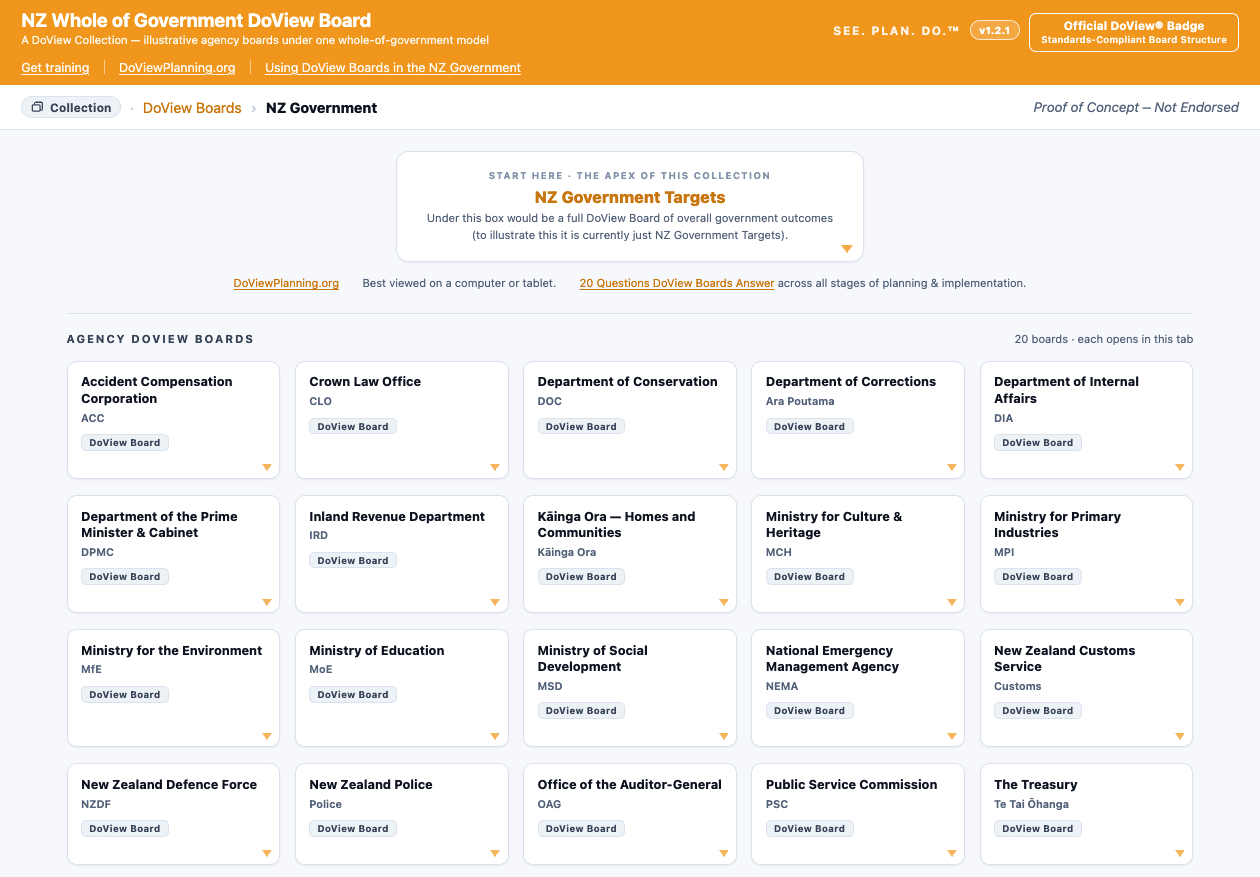
Click on the Proof-of-Concept NZ Whole-of-Government DoView Board Collection below. It demonstrates how AI-generated, interactive, fully editable DoView Boards can be built to model any level of the NZ government. At the moment, the current NZ Government Targets are at the top of the collection, however any set of outcomes in areas of public interest can be modeled at the top of such a collection. When looking at agency boards click on Page View in the top menu and Select All to see the richness of the elements that can be modeled within a DoView Board.
The committee recommended three shifts. A DoView Board delivers all three:
Whole-of-government reporting — priorities, the plan beneath them, and progress, in one drill-down.
Areas of public interest — visualizing outcomes in areas that matter to people.
Public entities' reporting — each entity's priorities, performance, value for money, and contribution to outcomes, shown in context.
"You wouldn't build a building without a blueprint. Don't run a government without a map of what it's trying to do."
There is no reason why DoView Boards cannot be piloted now at the government agency level based on existing government reporting documentation. This would mean that their potential contribution to whatever reporting approach is finally adopted by the government following the review could be assessed.
See the 20 key questions that a DoView Board answers for those running or overseeing any organization or initiative. Use the free AI prompt to build a DoView Board about anything now.
Recommendations of the Inquiry Into Performance Reporting and Public Accountability With Comments about How DoView Boards Could Contribute
Below is the executive summary of the Review’s report. Each recommendation is followed by a note regarding how a visual NZ Whole-of-Government DoView Board Collection could complement the base reporting documentation that needs to be produced by government if the Review’s recommendations are accepted. DoView Boards are designed to answer the 20 key questions that need to be answered for anyone managing or having oversight of any organization. In the case of each recommendation, particularly relevant questions from the 20 questions are noted.
The Finance and Expenditure Committee has conducted an inquiry into performance reporting and public accountability, and makes the following recommendations:
Our overarching recommendation
1. We recommend that the Government develop and implement the proposals set out in Chapter 3.1, 3.2, and 3.3 of this report to improve the systems for performance reporting and public accountability, focused on three key shifts:
Whole-of-government reporting—improving clarity about what governments want to achieve, how they intend to go about it, and what progress is being made.
By providing a visual ‘gateway’ above the base performance documentation produced by government agencies, a NZ Whole-of-Government DoView Board Collection (as in the proof-of-concept above) could offer a very accessible visual whole-of-government approach to reporting. It would sit above the more detailed documentation recommended by the Review and provide a visual drill-down interactive gateway to what government wants to achieve, how it intends to go about it, and what progress is being made. Because they have been designed to answer the 20 key questions that need to be answered regarding any organization or initiative, DoView Boards can provide a comprehensive helicopter and drill-down view for whole-of-government reporting. And the board collection would be usable by a much wider group of people than typically access, of necessity, much denser government base reporting documentation.
In particular, see:
1. What outcomes, for whom? https://doviewplanning.org/20questions#question1
2. How will change happen? https://doviewplanning.org/20questions#question2
7. What specific action will be taken? https://doviewplanning.org/20questions#question7
18. How are results being reported? https://doviewplanning.org/20questions#question18
Reporting on areas of interest to the public—strengthening the focus of reporting on how the Executive's work and spending contributes to outcomes in areas that are important to the public.
A DoView Board Collection enables quick, comprehensive, large-scale modelling of outcomes sets at any level. These can be at a government agency level, but it is equally easy to visually model outcomes from the point of view of areas that are particularly important to the public. DoView Boards are designed to enable mapping sets of projects/activities onto multiple outcomes sets. Presenting outcomes in areas that are important to the public within a DoView Board enables anyone to rapidly navigate through the board to see how government activity is focused on areas of interest to the public.
In particular, see:
1. What outcomes, for whom? https://doviewplanning.org/20questions#question1
2. How will change happen? https://doviewplanning.org/20questions#question2
7. What specific action will be taken? https://doviewplanning.org/20questions#question7
8. Is the action aligned with priority outcomes? https://doviewplanning.org/20questions#question8
18. How are results being reported? https://doviewplanning.org/20questions#question18
Public entities' reporting—providing a more integrated view of the performance of entities, with a greater focus on value for money and how they are contributing to outcomes.
DoView Boards provide a novel visual approach to providing an integrated view of entities' performance and checking that there is alignment between priorities and what is being done, so government can show how it believes its work is value for money and contributing to outcomes.
In addition to the questions from the 20 questions listed above, in particular, see:
8. Is the action aligned with priority outcomes? https://doviewplanning.org/20questions#question8
10. How will budget/funding be used? https://doviewplanning.org/20questions#question10
16. How are answers to evaluation questions being shown? https://doviewplanning.org/20questions#question16
18. How are results being reported? https://doviewplanning.org/20questions#question18
Whole-of-government reporting
2. To improve whole-of-government reporting, we recommend that the Government develop and implement the following proposals, which would require each Government to:
state its priority objectives near the start of the parliamentary term
A DoView Board Collection provides the most efficient, accessible and transparent way for a government to set its priorities at the start of the parliamentary term. Ministers simply need to mark up the government’s priorities onto the boxes on the appropriate level within the relevant DoView Boards. This then provides a quickly accessible visual representation of the government’s priorities located within the context, also modeled in the DoView Board of how it is planning to focus on those priorities. In particular, see:
6.Which priorities matter most next? https://doviewplanning.org/20questions#question6
provide a high-level plan, with costings, to outline major initiatives it will carry out to achieve its priority objectives
The amount being spent in different priority objective areas can be marked up on to the boxes within the relevant DoView Boards.
In particular, see:
7. What specific action will be taken? https://doviewplanning.org/20questions#question7
10. How will budget/funding be used? https://doviewplanning.org/20questions#question10
report on progress towards achieving the priority objectives. DoView Boards are specifically designed to enable reporting of both performance measures (indicators, KPIs, targets etc.) and the results of implementation, process and impact evaluation findings. URLs from the DoView Board could then drill down to more detailed indicators graphs and visualizations. Or given that DoView Boards are an open-source project, such visualizations and the DoView Board could be easily integrated into a single NZ government planning and reporting IT infrastructure.
In particular, see:
15. How is progress on measures being shown (e.g. indicators, KPIs, OKRs)? https://doviewplanning.org/20questions#question15
16. How are answers to evaluation questions being shown? https://doviewplanning.org/20questions#question16
Reporting on areas of interest to the public
3. To improve reporting on areas of interest to the public, we recommend that the Government develop and implement the following proposals:
establish a set of enduring outcomes for key areas of public interest
DoView Boards provide a fully flexible approach to specifying enduring outcomes consistent with this recommendation. The rules for drawing DoView Boards encourage exactly this. Rule 8 is: Future-proof the DoView by building one that shows everything that needs to happen over time. Then identify current priorities onto the DoView. This rule was explicitly developed to ensure DoViews can remain relevant over time and be used by different administrations because different administrations can simply map their different priorities onto the same DoView. This contrasts with approaches in which the underlying outcomes model must change whenever there is a different government administration. Of course, there may be circumstances in which a particular government wants to change certain aspects of the underlying DoView model, and this can be done easily using the visual approach within an editable DoView Board. However, most of the time, different administrations may find that they can clearly specify their priorities against an existing DoView Board's set of enduring outcomes, and this makes transitions between government administrations more efficient from the planning and rapid implementation point of view.
In particular, see:
1. What outcomes, for whom? https://doviewplanning.org/20questions#question1
2. How will change happen? https://doviewplanning.org/20questions#question2
require the Government of the day to set out its priority objectives related to each key area of public interest. As referred to just above, the most efficient approach to government priority setting is for the government of the day to have Ministers go through the DoView Boards for which they are responsible and mark up their priorities onto the boxes within the board. When doing this, they will also want to be able to discuss trade-offs and options (which can be done within a DoView Board) and will want to know what progress has been made at the particular point in time on boxes within the DoView (which can be done by traffic-lighting boxes within the DoView Board). This is a much more efficient approach than just relying on separate documentation, such as Ministerial Letters of Intent. Such letters can be written, but the most efficient way to ensure that their content actually translates into agency priorities is to map the priorities in such documentation onto the relevant boxes within the DoView Board the agency is working from. It is also a much more strategically agile approach. When the strategy environment changes, Ministers just need to go through the DoView Board, change the priority of boxes that they want to change. Then the relevant government agency(s) use DoView Board visual alignment to show what they are going to do differently to ensure that their future activity is tightly aligned to key areas of public interest.
In particular, see:
5. What options and trade-offs were considered? https://doviewplanning.org/20questions#question5
6. Which priorities matter most next? https://doviewplanning.org/20questions#question6
8. Is the action aligned with priority outcomes? https://doviewplanning.org/20questions#question8
require the Executive to set out information about how spending is related to the enduring outcomes and the Government's priority objectives
A Whole-of-Government DoView Board Collection enables information about how much is being spent on which outcomes to be presented within the set of boards. It also enables a Minister or anyone using the Board to immediately drill down to see more detailed information about which projects and activities (which can also include the amount being spent on them) are focused on achieving the outcomes in question. URLs can link out from the relevant DoView Board to more detailed visualizations of spending (e.g. the example given in the Review report). In addition, because DoView Boards are an open-source project, any developer can easily incorporate them into an integrated government IT infrastructure which means they would be connected to visualizations such as the spending one included in the report. So such a spending visualization would, in essence, be one view of what is already included within the DoView Board.
In particular, see:
8. Is the action aligned with priority outcomes? https://doviewplanning.org/20questions#question8
10. How will budget/funding be used? https://doviewplanning.org/20questions#question10
require the Executive to report its progress on outcomes across each key area of interest.
A Whole-of-Government DoView Board Collection provides the visualization (e.g. traffic lighting) for both performance measures and the findings in regard to evaluation questions with which the Executive can rapidly communicate its progress on outcomes across each key area of interest. URLs can link out from the relevant DoView Board to the relevant, more detailed documents (e.g. evaluation reports). In addition, because DoView Boards are an open-source project, any developer can easily incorporate them into an integrated government IT infrastructure and this could include repositories of such documents.
In particular, see:
15. How is progress on measures being shown (e.g. indicators, KPIs, OKRs)? https://doviewplanning.org/20questions#question15
16. How are answers to evaluation questions being shown? https://doviewplanning.org/20questions#question16
18. How are results being reported? https://doviewplanning.org/20questions#question18
Public entities' reporting
replace current requirements related to entities preparing strategic documents with a new requirement for public entities to produce a four-year plan
Entities’ four-year plans can be turned into fully functional DoView Boards within minutes using the free DoView Board Prompt. The reality is that only a tiny number of people read government four-year plans. Complementing their production by also turning them into very accessible DoView Boards means that a far wider audience can quickly access the information within such plans. Readers can get both a helicopter and a drill-down view within the relevant DoView Board to obtain more detail. The boards can visualize how each of the projects or activities within the four-year plans is aligned with priority outcomes. They can also detail exactly what performance measures the entity is going to use and which boxes within the DoView each measure relates to. In addition, DoView Boards are designed to detail the implementation, process and outcome evaluation questions that are going to be answered in regard to the work of the entity.
In particular, see:
1. What outcomes, for whom? https://doviewplanning.org/20questions#question1
2. How will change happen? https://doviewplanning.org/20questions#question2
7. What specific action will be taken? https://doviewplanning.org/20questions#question7
8. Is the action aligned with priority outcomes? https://doviewplanning.org/20questions#question8
15. How is progress on measures being shown (e.g. indicators, KPIs, OKRs)? https://doviewplanning.org/20questions#question15
16. How are answers to evaluation questions being shown? https://doviewplanning.org/20questions#question16
require public entities to provide targeted information on their performance, including value for money, how they are contributing to outcomes, and findings from evaluations and reviews
All of this information can be captured within the relevant DoView Board, complementing all of the detailed information provided in reporting documentation produced by entities. This information is then immediately available in a visual drill-down format within the DoView Board so that anyone can quickly get a picture of exactly what an entity is attempting to do and the progress that it is making at any point in time.
In particular, see:
8. Is the action aligned with priority outcomes? https://doviewplanning.org/20questions#question8
10. How will budget/funding be used? https://doviewplanning.org/20questions#question10
15. How is progress on measures being shown (e.g. indicators, KPIs, OKRs)? https://doviewplanning.org/20questions#question15
16. How are answers to evaluation questions being shown? https://doviewplanning.org/20questions#question16
remove existing requirements for entities to report on performance at an appropriations level; entities would continue to report on spending against appropriations. Consistent with this recommendation, DoView Boards provide a visual approach to providing a much more fine-grained reporting of performance than that which was previously done at the appropriations level.
In particular, see:
15. How is progress on measures being shown (e.g. indicators, KPIs, OKRs)? https://doviewplanning.org/20questions#question15
18. How are results being reported? https://doviewplanning.org/20questions#question18
Additional proposals
Requiring a statement of enduring long-term outcomes for New Zealand that sits above outcomes for key areas and endures beyond parliamentary cycles
In addition to whatever other documentation that is produced, this can be easily modeled in an accessible visual format within a DoView Board Collection.
In particular, see:
1. What outcomes, for whom? https://doviewplanning.org/20questions#question1
2. How will change happen? https://doviewplanning.org/20questions#question2
Establishing long-term objectives that can endure across governments for issues that need sustained focus
In addition to whatever other documentation is produced, this can be easily modeled in an accessible visual format within a DoView Board Collection.
In particular, see:
1. What outcomes, for whom? https://doviewplanning.org/20questions#question1
6. Which priorities matter most next? https://doviewplanning.org/20questions#question6
Requiring a state-of-the-nation report that provides a comprehensive picture of progress towards long-term outcomes
In addition to whatever other documentation is produced to do this, this can be easily modeled in an accessible visual format within a DoView Board Collection to increase the reach of information about progress towards long-term outcomes
In particular, see:
15. How is progress on measures being shown (e.g. indicators, KPIs, OKRs)? https://doviewplanning.org/20questions#question15
18. How are results being reported? https://doviewplanning.org/20questions#question18
requiring briefings on long-term trends, challenges, and opportunities in key areas of interest
In addition to whatever other documentation is produced to do this, this can be easily modeled in an accessible visual format within a DoView Board Collection. The rules for drawing This-Then pages within a DoView Board are such that they can capture trends, challenges, risks and opportunities within the set of This-Then pages in a DoView Board.
In particular, see:
2. How will change happen? https://doviewplanning.org/20questions#question2
4. What could affect success? https://doviewplanning.org/20questions#question4
Requiring the Government to provide a high-level plan of major initiatives related to key areas of interest.
Because DoView Boards take a generic approach to modeling outcomes, steps and the projects/actions it is believed will lead to them, they can be used (and have been used in earlier iterations of DoView Planning with the NZ public service) to model a wide variety of different types of initiatives focused on areas of interest at the departmental unit level, the departmental level, the provider level, the sector level and at the national level.
In particular, see:
1. What outcomes, for whom? https://doviewplanning.org/20questions#question1
2. How will change happen? https://doviewplanning.org/20questions#question2
7. What specific action will be taken? https://doviewplanning.org/20questions#question7
Reference: [1] Report on Inquiry into performance reporting and public accountability. New Zealand House of Representatives Finance and Expenditure Committee May 2026.