
The 20 Questions That DoView Boards Answer
See DoView Boards for a high-level introduction and DoView Boards How-To for screenshots of how to use them. This page for details of how you use a DoView Board to answer the key questions about any initiative
Quick Overview
DoView Boards are the faster, innovative way of doing (and proving you are doing) all aspects of outcomes-based planning, implementation, measurement and reporting. They can be used with organizations, strategies, policies, projects, joint ventures, collaborations, sectors and initiatives of any sort in any setting. They can be used for human organizations, human-AI collaborations and potentially for AI agents so they can report back to humans on what they are doing. This page provides details on how you can use DoView Boards.
There are 20 key questions that need to be answered for comprehensive planning, implementation, improvement and reporting on any initiative of any type, and DoView Boards are the lightweight way of answering all of these.
Note that the current implementation of DoView Boards created with the prompts available on this site is a prototype. Use it to pilot and test if the approach adds value, but at the moment, maintain your other planning and implementation documentation as a backup.
Below are the 20 questions that DoView Boards allow you to quickly answer about any initiative you are running or you want to have oversight of.
Challenge: Find any other lightweight app (no app install, runs in a browser window) that answers these 20 questions about any initiative in one place.
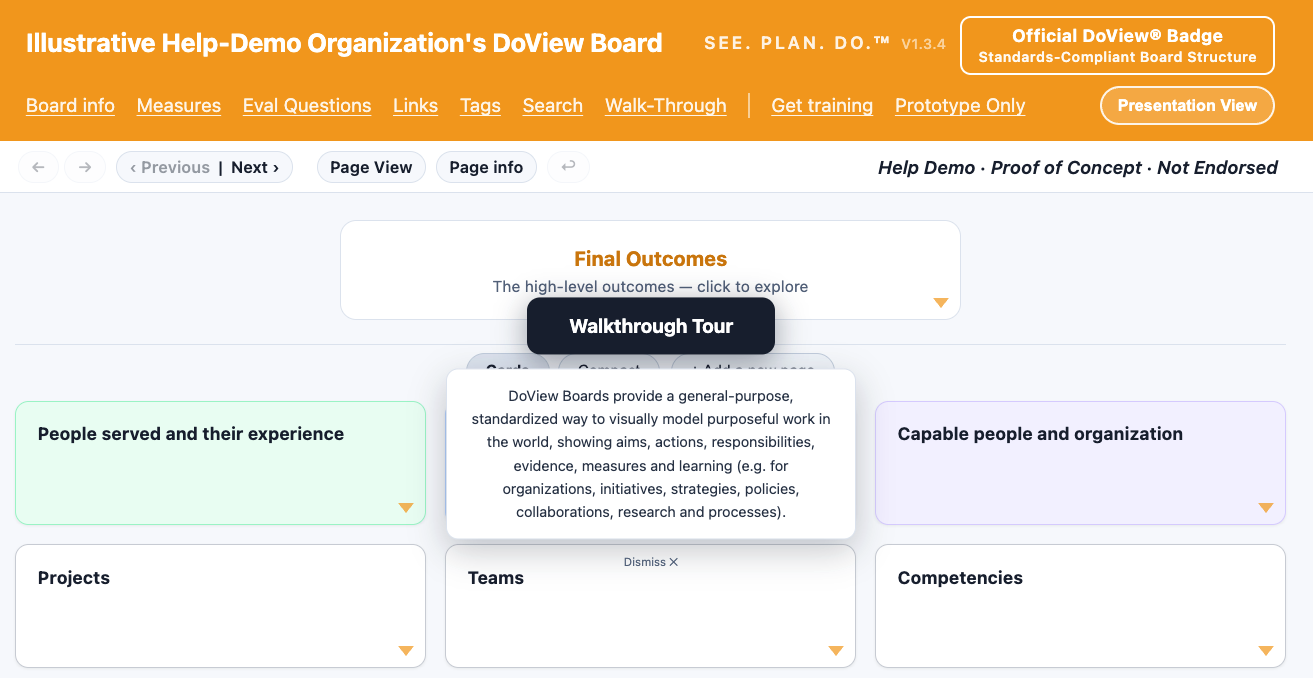
Below is a comprehensive DoView Board Walkthrough, which covers the features of DoView Boards. You can access this at any time by clicking on Walkthrough in the top menu of any DoView Board.
The 20 Key Questions
SEE
1. What outcomes, for whom?
What outcomes are being sought, for whom, and what opportunities are there for input to ensure alignment with mandates, obligations and stakeholder intent?
2. How will change happen?
What steps are expected to lead to those outcomes, and is the intervention logic (theory of change) robust?
3. What evidence supports claims regarding change?
What evidence and best practice information supports the proposed approach, and where is evidence from the past weak or uncertain?
4. What could affect success?
What assumptions, risks, dependencies, constraints, and system factors affect success?
PLAN
5. What options and trade-offs were considered?
Why were particular options and trade-offs chosen, and what will not be done as a result?
6. Which priorities matter most next?
Which outcomes and steps are the priorities that will be focused on in the next planning period?
7. What specific action will be taken?
Which projects, services, or activities are going to be undertaken?
8. Is the action aligned with priority outcomes?
How can we know that each project or activity is tightly aligned to priority outcomes?
9. What capabilities, etc., are needed?
What people, systems, relationships, data, and competencies are required?
10. How will budget/funding be used?
How will budget and funding be allocated, and why is this the best use of these?
11. Who can make what decisions?
Who can approve changing, stopping, escalating, or reprioritizing the work, and what are the criteria for such changes?
12. Who is accountable/contracted for doing what?
Who is responsible for what delegated or contracted accountabilities, including staff, contractors, partners, and agencies?
13. What is the performance measurement/evaluation plan?
What is the plan for collecting, analyzing and disseminating performance management and evaluation information?
DO
14. How are parties coordinating?
How are the different parties coordinating, sharing information, and resolving conflicts?
15. How is progress on measures being shown (e.g. indicators, KPIs, OKRs)?
How is information on metrics, indicators, milestones, targets etc. being shown to measure progress?
16. How are answers to evaluation questions being shown?
What evaluation questions are being answered, and how are implementation and impact evaluation results being shown?
17. How is delivery being improved?
How is ongoing implementation of the work being improved as it progresses?
18. How are results being reported?
How is what is being done, its impact and results being comprehensively reported back to relevant parties?
19. How is knowledge management being handled?
How is knowledge and information about the initiative being handed on to others if staff or those delivering the work change?
20. How is the work being sustained?
How is the work being sustained, scaled, embedded, handed over to others, or ultimately exited?
1. What outcomes, for whom?
What outcomes are being sought, for whom, and what opportunities are there for input to ensure alignment with mandates, obligations and stakeholder intent?
What outcomes are being sought, for whom, and what opportunities are there for input to ensure alignment with mandates, obligations and stakeholder intent?
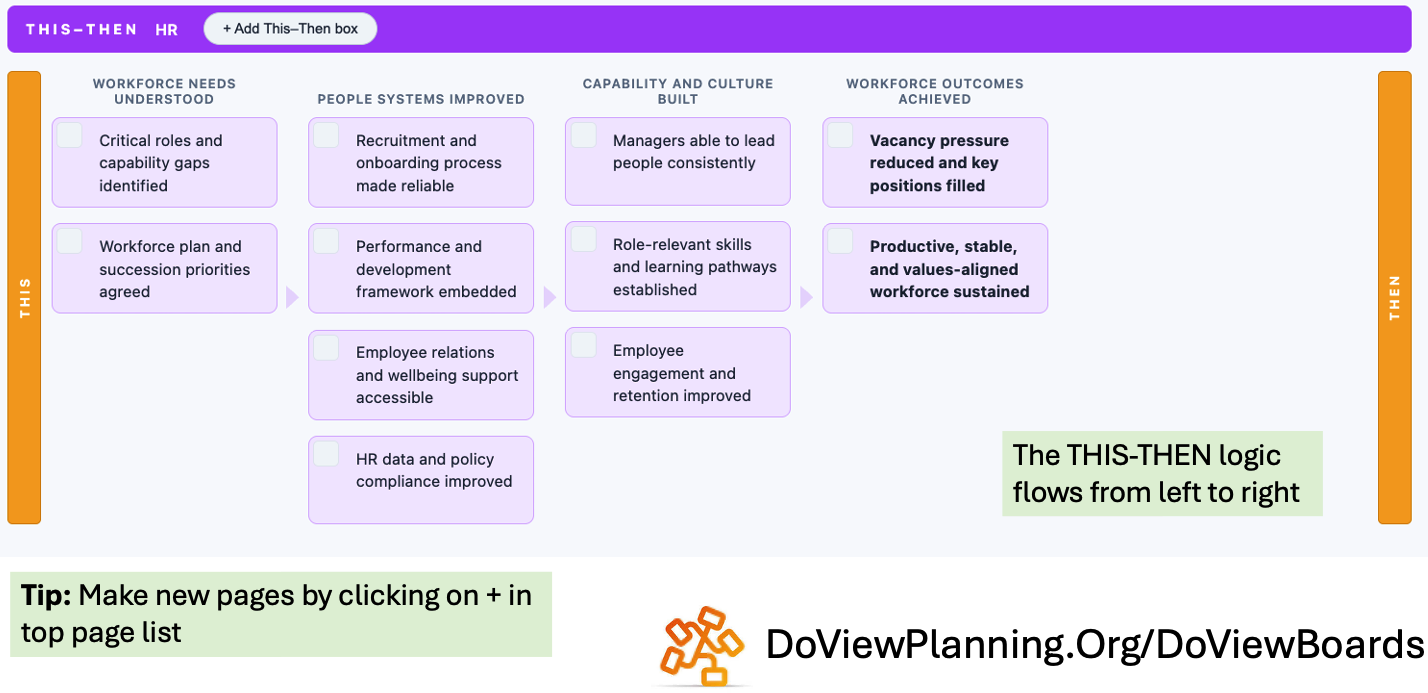
Draw This-Then pages for the outcomes being sought and the steps believed to lead to them. Do this by hand, or paste the free AI prompt into ChatGPT or Claude and tell it what the board is about.
Amend and agree with decision-makers or stakeholders the draft pages so they truly represent what is being attempted.
Use the board for every discussion about outcomes, with governance, management, staff, contractors, providers, funders and stakeholders.
If you also have to show alignment with another party's outcomes, put their outcomes on their additional This-Then pages and link your projects and activities up to them. You can copy pages in from another board.
The This-Then pages become the single shared picture of what is being attempted. Every later discussion starts from them.
Walkthrough where this is illustrated
The video below will start at the relevant section.
2. How will change happen?
What steps are expected to lead to those outcomes, and is the intervention logic (theory of change) robust?
What steps are expected to lead to those outcomes, and is the intervention logic (theory of change) robust?
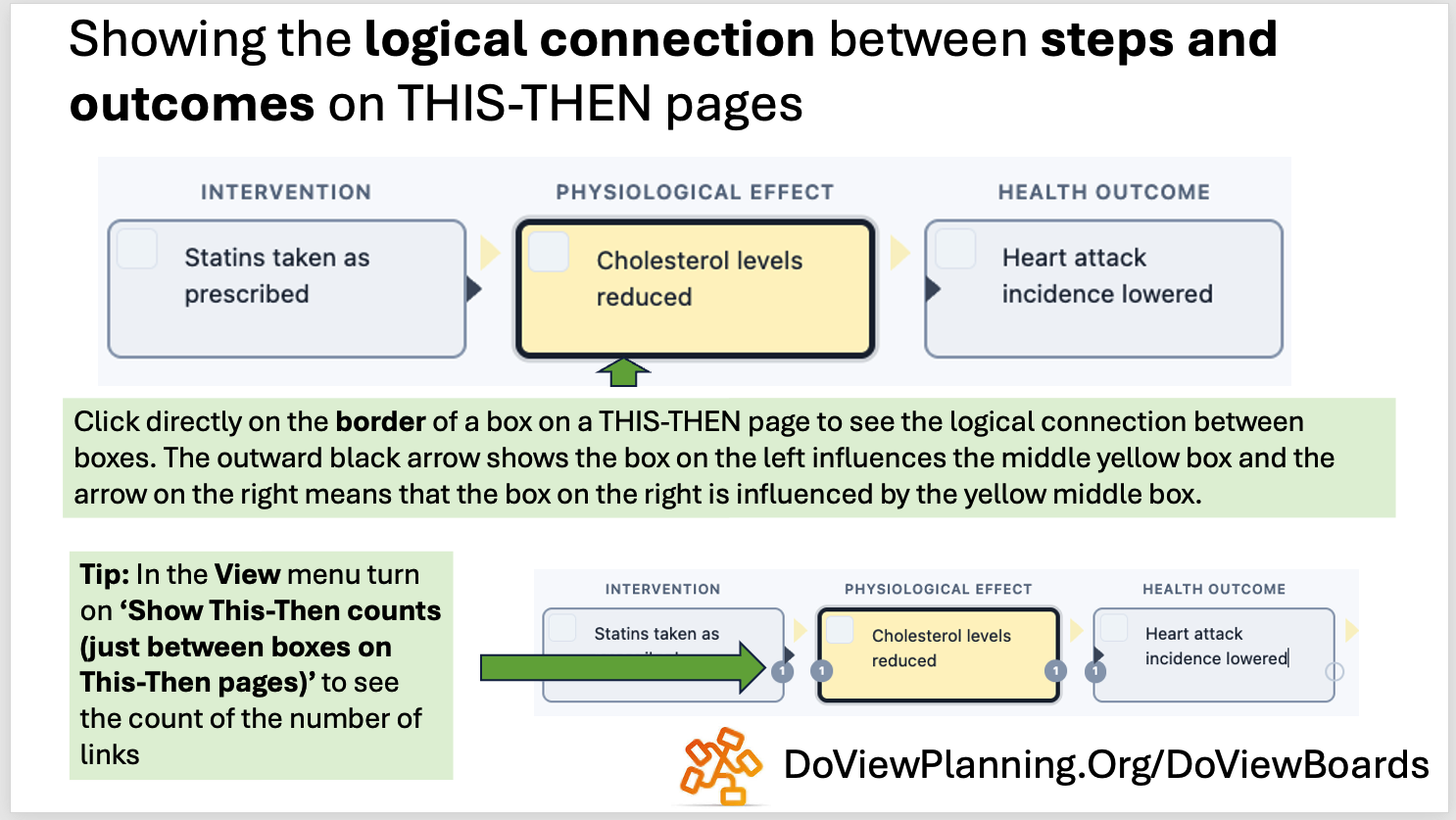
Add links between This-Then boxes to show which steps are believed to make other steps and outcomes happen.
Read these links as your intervention logic, the way you expect to reach higher-level outcomes. AI can draft a first set of links for you to amend and agree.
Have the logic checked. An independent expert, or an independent AI, can look at whether the links seem credible.
Many approaches claim a clear theory of change. Few show the logic of every step in one fine-grained visual model the way a DoView Board does.
Walkthrough where this is illustrated
The video below will start at the relevant section.
3. What evidence supports claims regarding change?
What evidence and best practice information supports the proposed approach, and where is evidence from the past weak or uncertain?
What evidence and best practice information supports the proposed approach, and where is evidence from the past weak or uncertain?
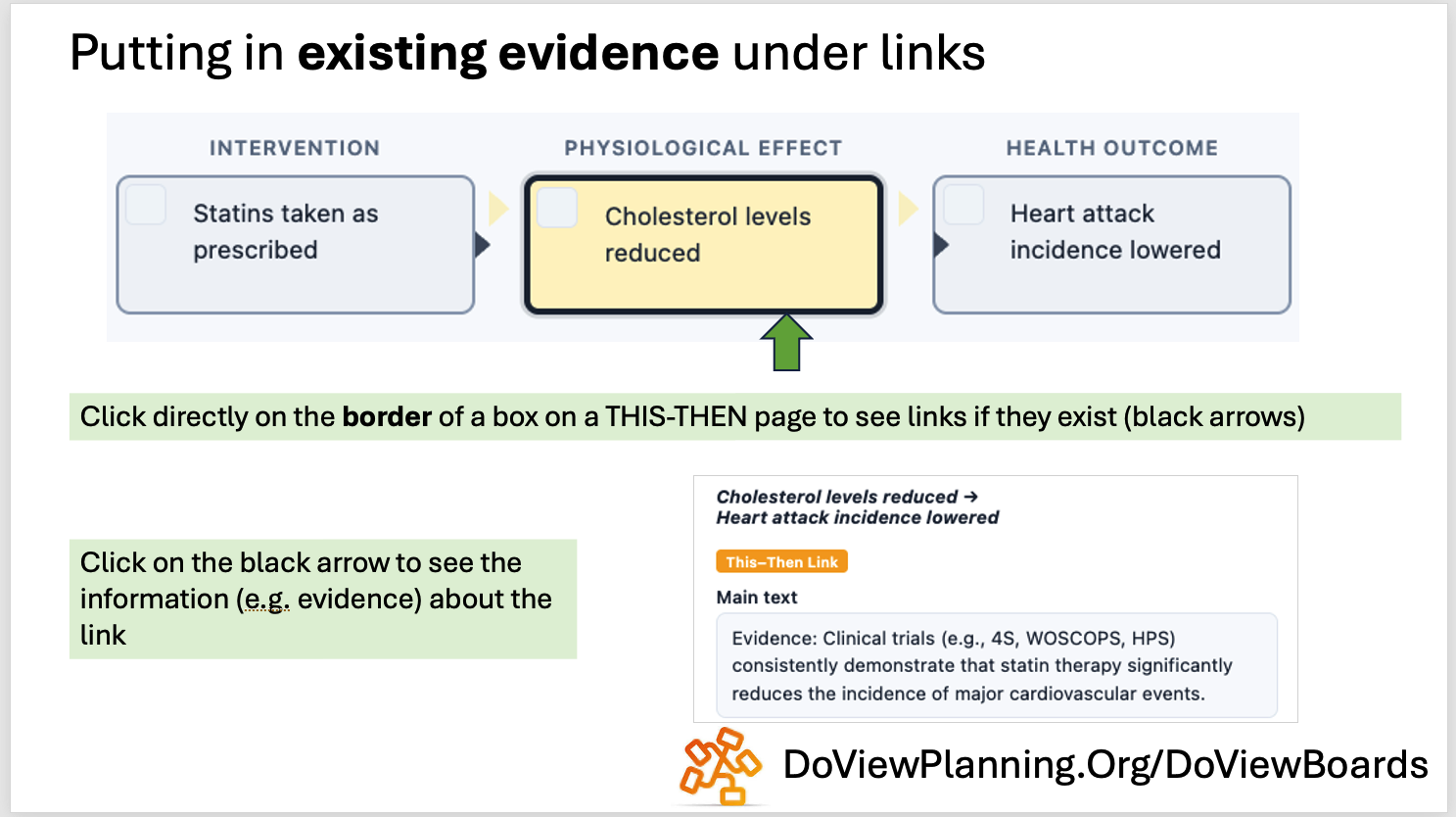
Click the border of a This-Then box, then click the small arrow on a link, and put the evidence or a sound rationale behind that link.
Use this to show, to a funder or anyone else, that the connections in your model are evidence-based.
AI can populate draft evidence under your links. You, an expert, or an independent AI can then check it.
The evidence sits behind the model, so the board stays simple on the surface while the support for each link is one click away.
Walkthrough where this is illustrated
The video below will start at the relevant section.
4. What could affect success?
What assumptions, risks, dependencies, constraints, and system factors may affect success?
What assumptions, risks, dependencies, constraints, and system factors affect success?
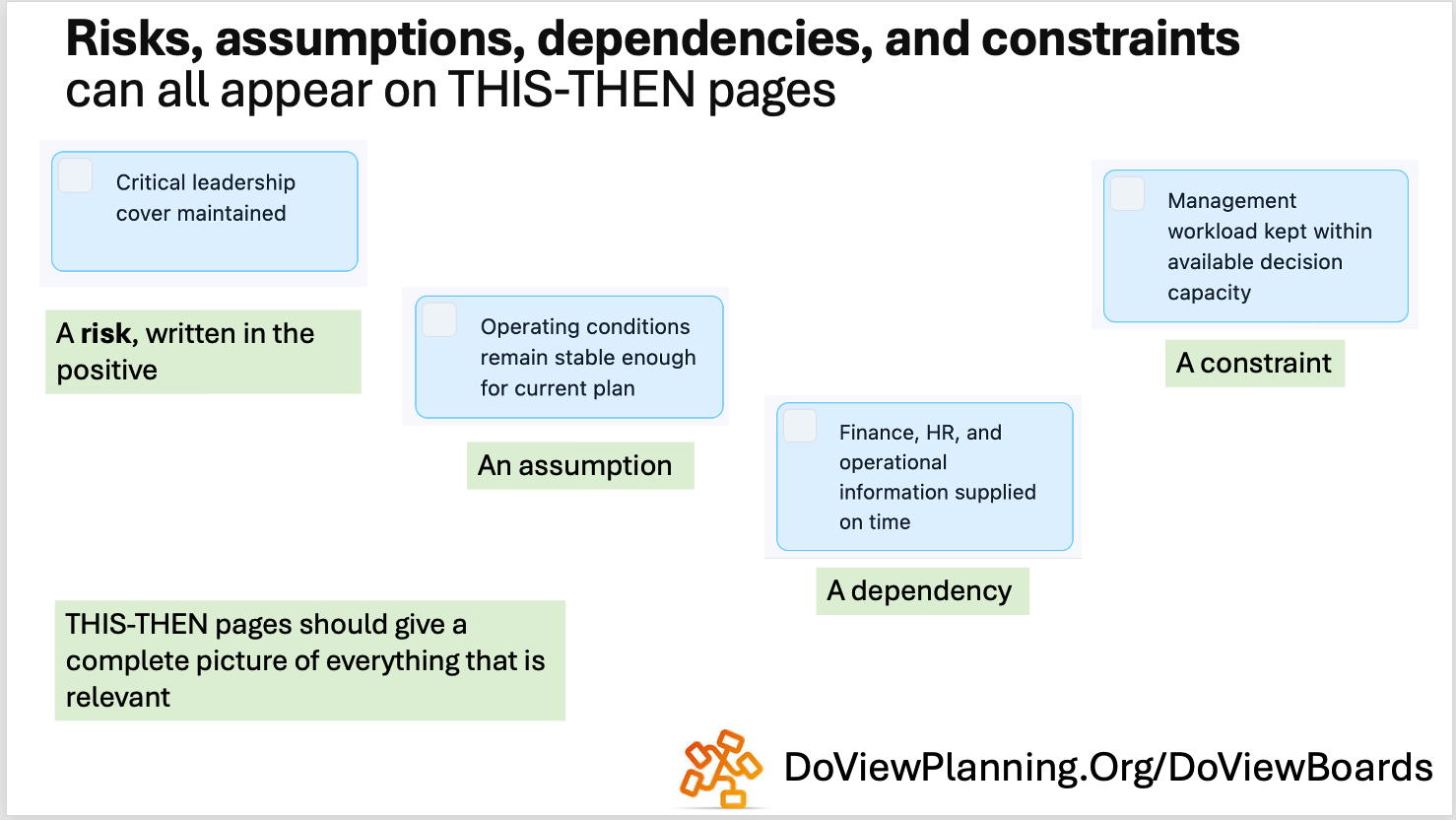
Put important risks and constraints on the This-Then pages as boxes, written as the result you want, the positive.
Put assumptions in as boxes too. Dependencies show up in the links between boxes.
Where one result works against another, use a negative link. Negative links show as red arrows.
Everything about the strategy space sits in one place. Risks and assumptions are not hidden in a separate table where decision-makers can miss them.
Walkthrough where this is illustrated
The video below will start at the relevant section.
5. What options and trade-offs were considered?
Why were particular options and trade-offs chosen, and what will not be done as a result?
Why were particular options and trade-offs chosen, and what will not be done as a result?
Use the This-Then pages to discuss options. You can build a What-If board with a different scenario on each page.
Mark the boxes you want to prioritize over others. This is where the trade-off is made visible.
For more detail, add negative links to show where boxes work against each other, then decide what to favour.
Options and trade-offs are hard to discuss well when people hold different mental models of what affects what. Seeing the pathways on a board gives everyone the same picture.
Walkthrough where this is illustrated
The video below will start at the relevant section.
6. Which priorities matter most next?
Which outcomes and steps are the priorities that will be focused on in the next planning period?
Which outcomes and steps are the priorities that will be focused on in the next planning period?
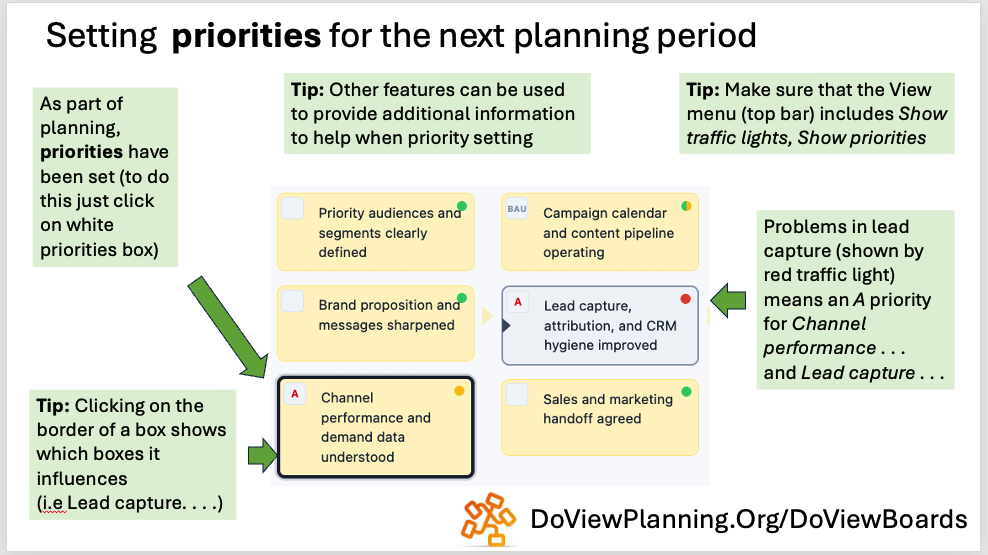
Mark the boxes that are priorities for the next planning period. Click the top left corner of a box to set a priority. Priorities can sit on This-Then boxes, How boxes, or both.
AI can put in draft priorities for you to amend and agree.
Use the board to discuss these priorities with anyone who needs to see them.
Priorities sit on top of the model. When priorities change, you re-tag boxes rather than rewrite the plan.
Walkthrough where this is illustrated
The video below will start at the relevant section.
7. What specific action will be taken?
What projects, services, or activities are going to be undertaken?
Which projects, services, or activities are going to be undertaken?
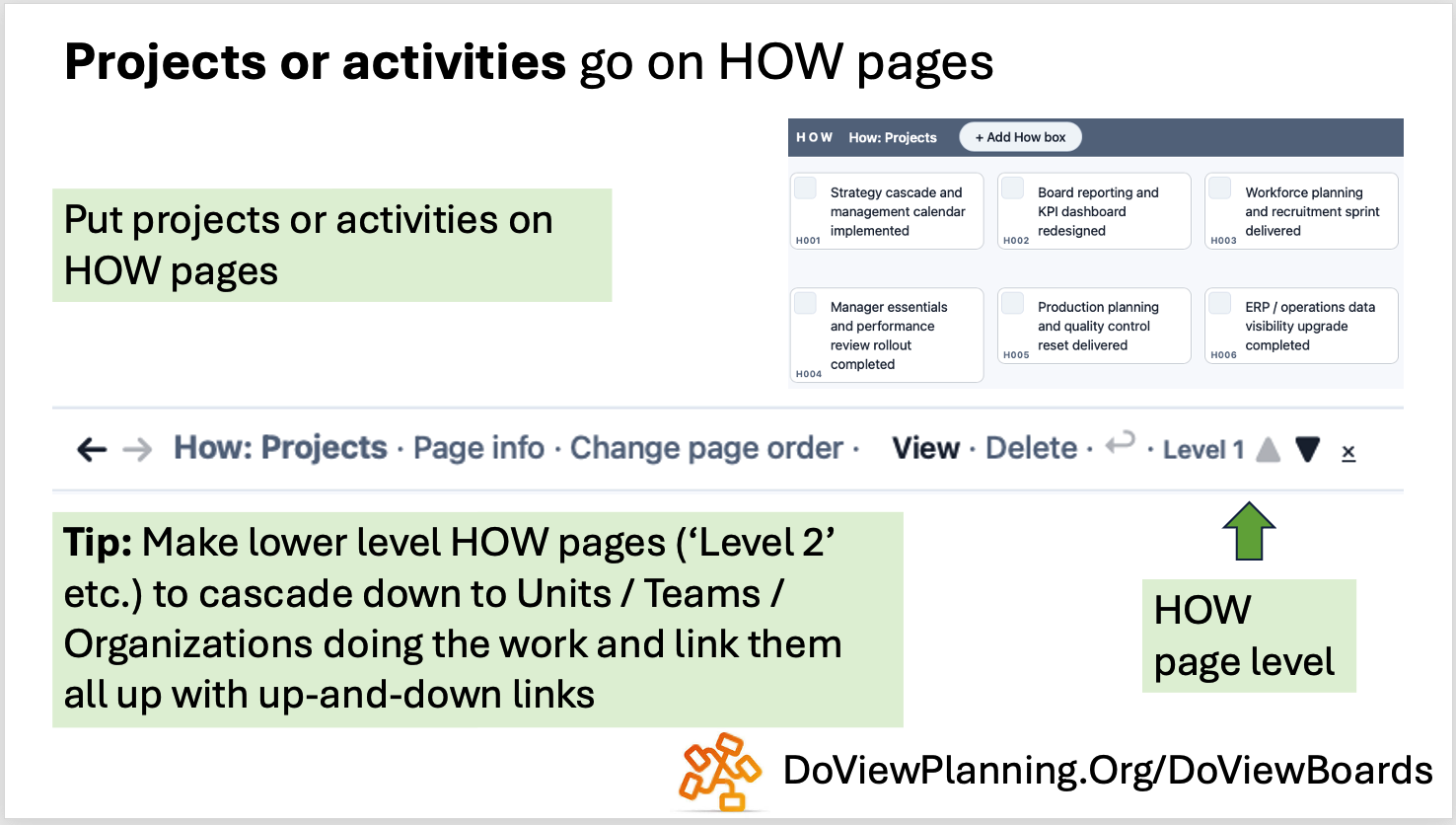
Add a How page with a box for each project, service or activity that will make the This-Then boxes happen.
Add more How pages beneath it for the next levels down, such as teams and then individuals or AI agents, linked with vertical links.
Put hyperlinks under a project box out to its page in any project tool you already use. So you do not do any rework.
For a large organization, initiative or sector the DoView Board holds the high-level outcomes logic and sits above your detailed project platform and tools, which hold the task detail, and you can drill down from a link in your DoView Board.
Walkthrough where this is illustrated
The video below will open at the right section.
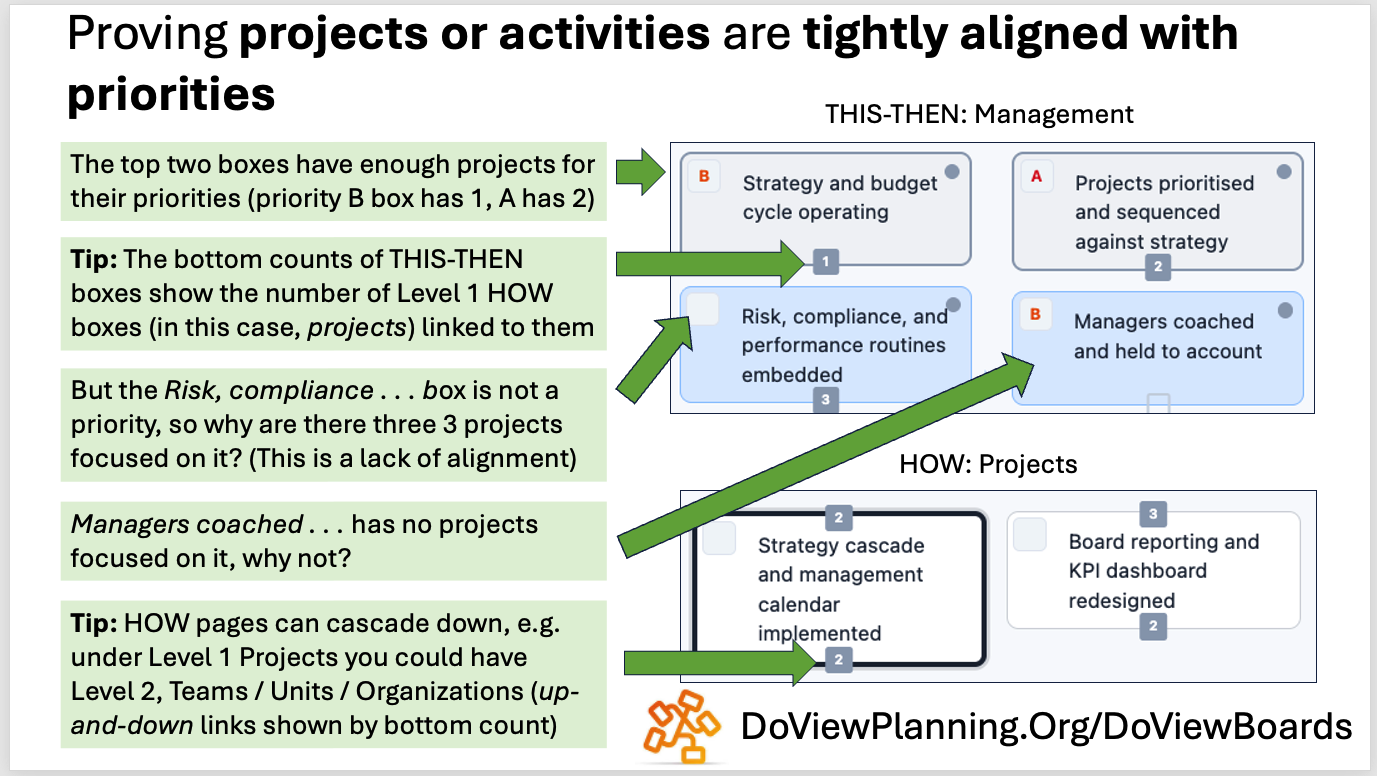
8. Is the action aligned with priority outcomes?
How can we know that each project or activity is tightly aligned to priority outcomes?
How can we know that each project or activity is tightly aligned to priority outcomes?
Put vertical links between How boxes and the This-Then boxes they are meant to achieve.
Look at the link counts. Check that priority This-Then boxes have enough effort behind them, and that low-priority boxes are not soaking up too much.
AI can do this check and flag any box where effort and priority do not match.
You can run perfect projects and still waste resources if effort is not aligned with priorities. The board lets you prove alignment at a glance.
Walkthrough where this is illustrated
The video below will start at the relevant section.
9. What capabilities etc., are needed?
What people, systems, relationships, data, and competencies are required?
What people, systems, relationships, data, and competencies are required?
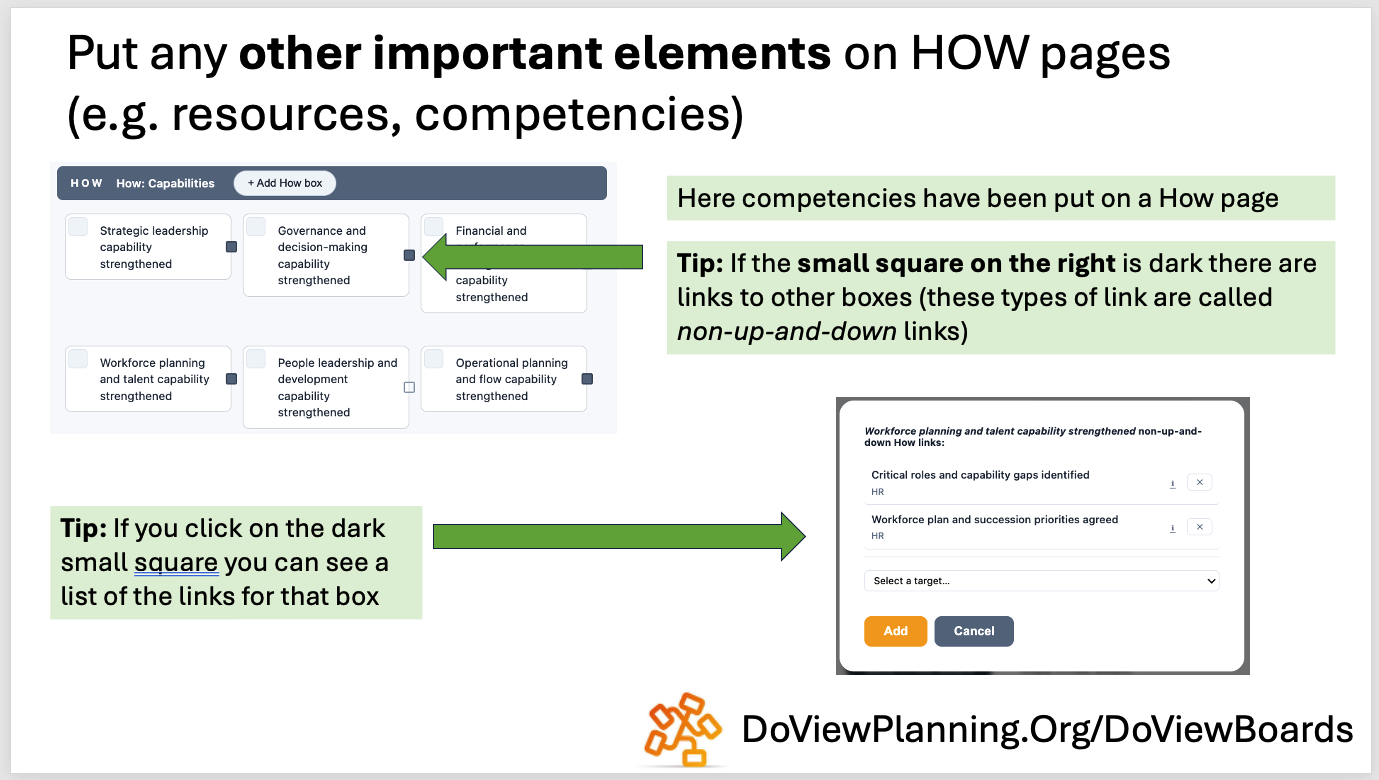
Put things like capabilities, competencies, relationships, data and systems on their own How pages.
Cross-link them sideways to the outcomes or steps (on This-Then pages) or projects or activities (on How pages) they support. A filled square on the side of a box shows it has cross-links.
Use this to see whether each project has the support it needs.
Cross-links make gaps visible. If an important project has nothing supporting it, that is worth a question.
Walkthrough where this is illustrated
The video below will start at the relevant section.
10. How will budget/funding be used?
How will budget and funding be allocated, and why is this the best use of these?
How will budget and funding be allocated, and why is this the best use of these?
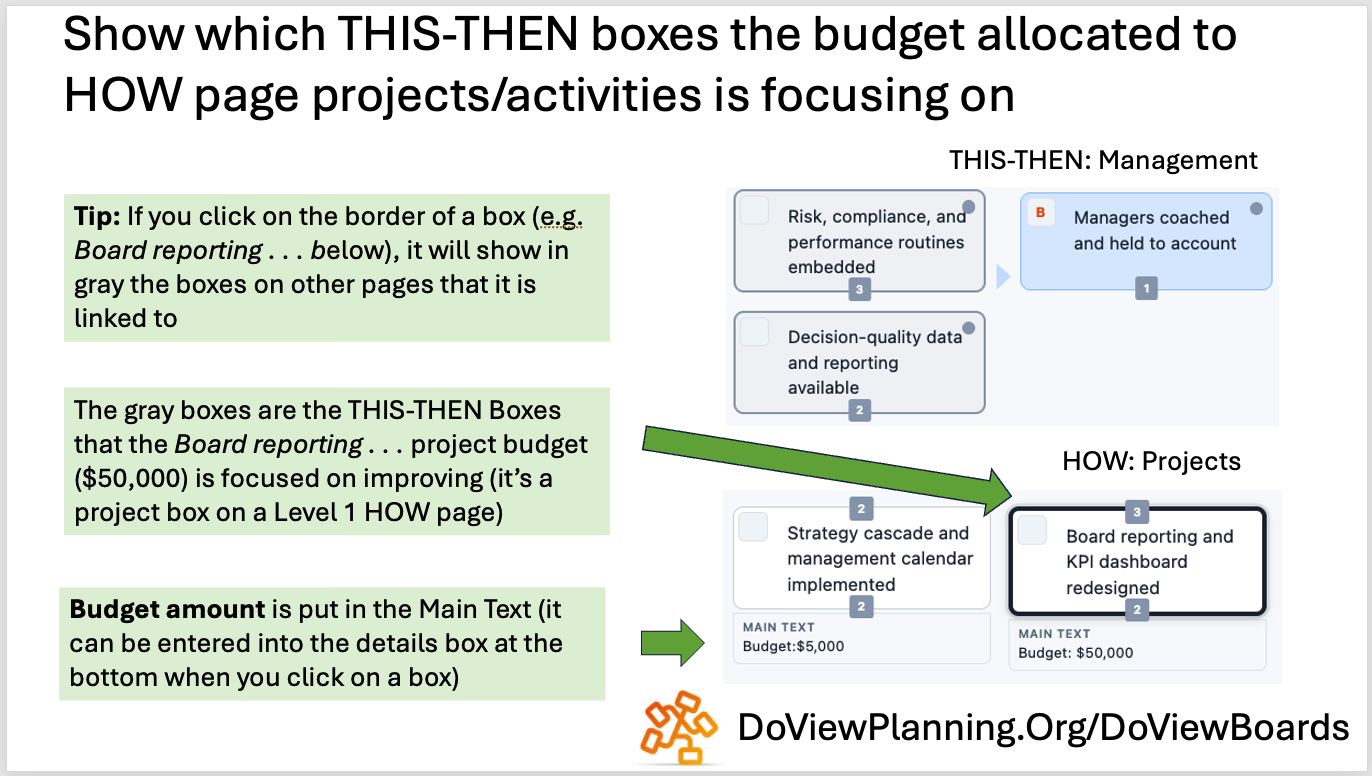
Record how much budget sits behind each How box, such as a project, in its details.
Use the vertical alignment from projects to This-Then boxes, as in question 8, to show, as far as possible, the steps and outcomes the money is aimed at.
Use this in any discussion to show where funding is going in outcome terms.
Because one project can affect several outcomes, exact apportioning is often not possible. The board still shows what the spend is buying far more clearly than just a list of budget lines.
Walkthrough where this is illustrated
The video below will open at the relevant section.
11. Who can make what decisions?
Who can approve changing, stopping, escalating, or reprioritizing the work, and what are the criteria for such changes?
Who can approve changing, stopping, escalating, or reprioritizing the work, and what are the criteria for such changes?
Record who can approve, change, stop, escalate or reprioritize the work, and the criteria for doing so.
Hold this on a Documentation page inside the board, or as boxes for people or roles that link to the work they govern.
Decision rights live in the same board as the work, so it is clear who can change what, and when.
Walkthrough where this is illustrated
The video below will start at the relevant section.
12. Who is accountable/contracted for doing what?
Who is responsible for what delegated or contracted accountabilities, including staff, contractors, partners, and agencies?
Who is responsible for what delegated or contracted accountabilities, including staff, contractors, partners, and agencies?
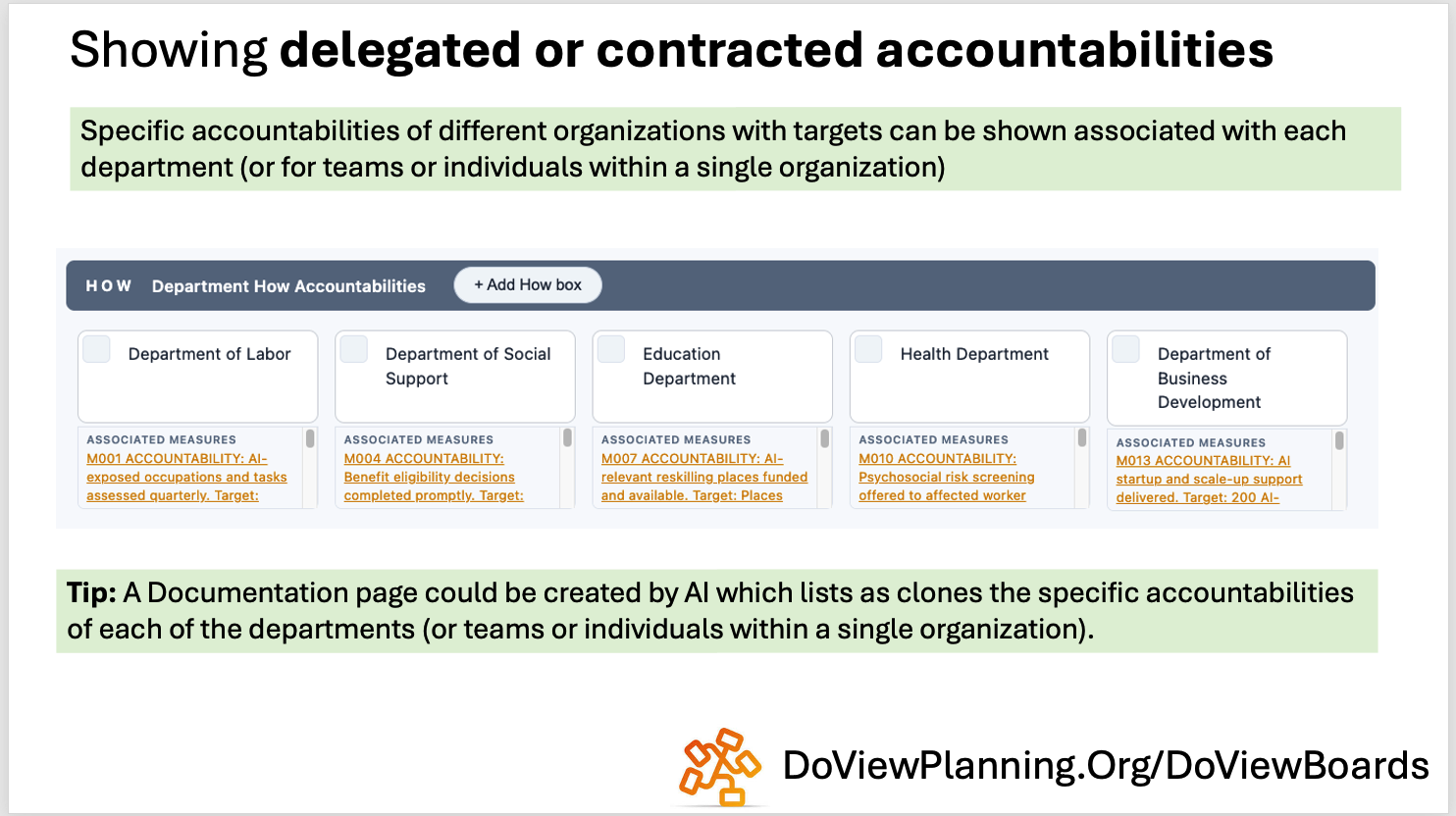
Link organizations, teams or individuals to the outcomes and steps they are responsible for.
Attach measures with targets to them as accountabilities, targets and deliverables.
Use the board as the source for contract documents, and attach a read-only copy of the relevant board to the contract.
Once a board is agreed, it is the single source of truth. Providers can see always see their deliverables, and how those deliverables fit within the context of the wider outcomes being sought.
Walkthrough where this is illustrated
The video below will start at the relevant section.
13. What is the performance measurement/evaluation plan? What is the plan for collecting, analyzing and disseminating performance management and evaluation information?
What is the plan for collecting, analyzing and disseminating performance management and evaluation information?
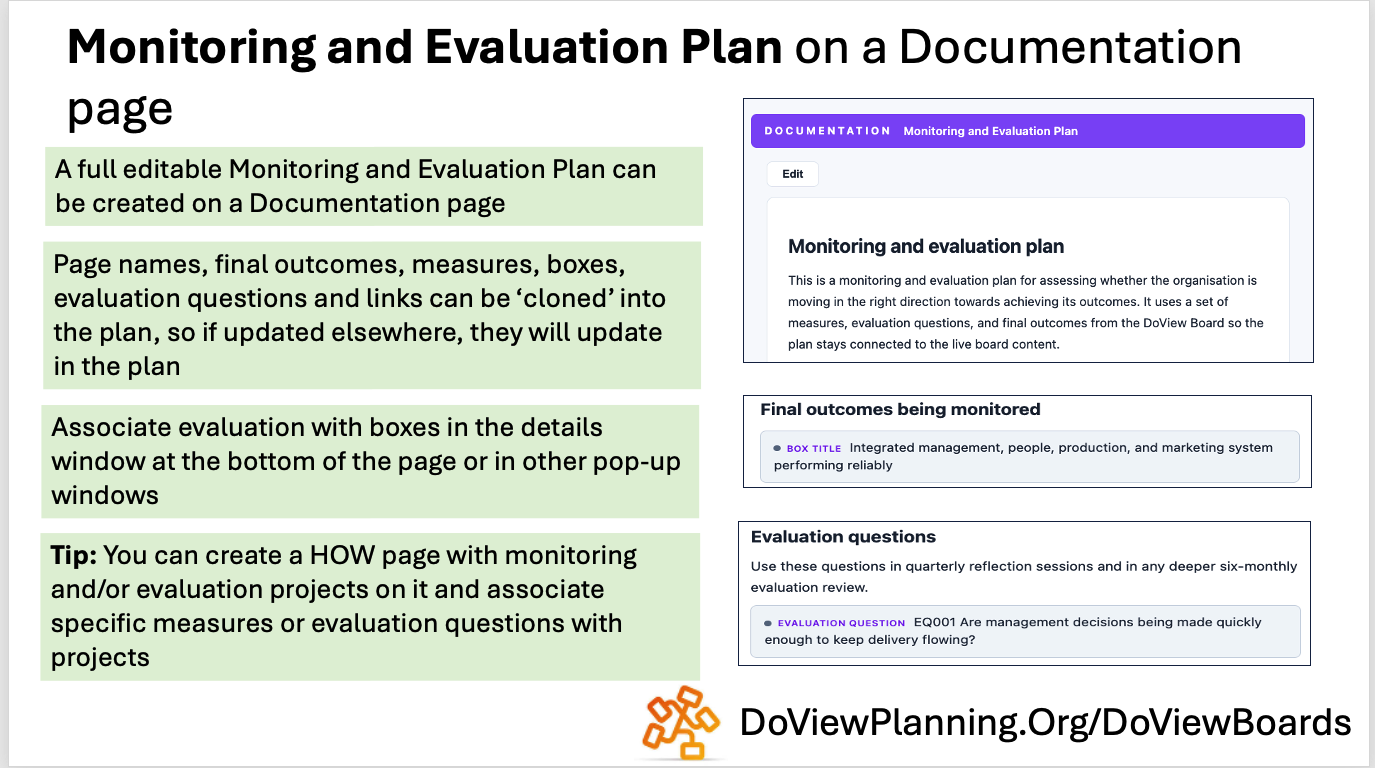
Write the performance measurement and evaluation plan on its own Documentation page inside the board.
Add a How page with boxes for the measurement or evaluation projects, and attach the measures and evaluation questions they cover.
Clone board elements, such as measures and questions, into the plan. When the source is edited, the clone updates too.
Strategy, measurement, evaluation and contracting can sit in one board, fully aligned and easy to keep current, instead of in separate documents.
Walkthrough where this is illustrated
The video below will start at the relevant section.
14. How are parties coordinating?
How are the different parties coordinating, sharing information, and resolving conflicts?
How are the different parties coordinating, sharing information, and resolving conflicts?
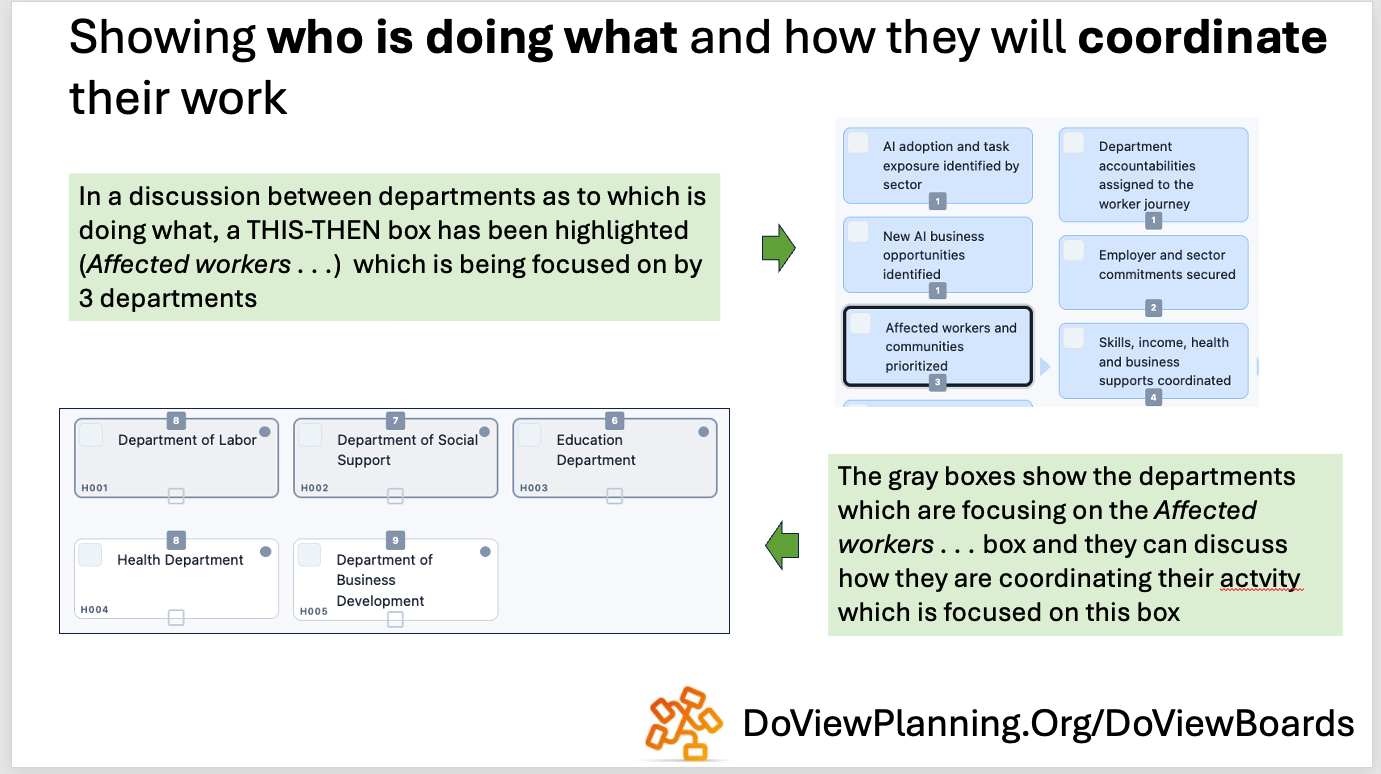
Map organizations, teams or individuals onto the outcomes and steps they are focusing on with vertical links.
Use the alignment view, as in question 8, to spot gaps and overlaps in who is doing what.
Use this picture to help the parties agree how they will coordinate.
When everyone can see who is working on what, gaps and double-ups are easy to find and resolve.
Walkthrough where this is illustrated
The video below will start at the relevant section.
15. How is progress on measures (e.g., indicators, KPIs, OKRs) being shown?
How is information on metrics, indicators, milestones, targets etc. being shown to measure progress?
How is information on metrics, indicators, milestones, targets etc. being shown to measure progress?
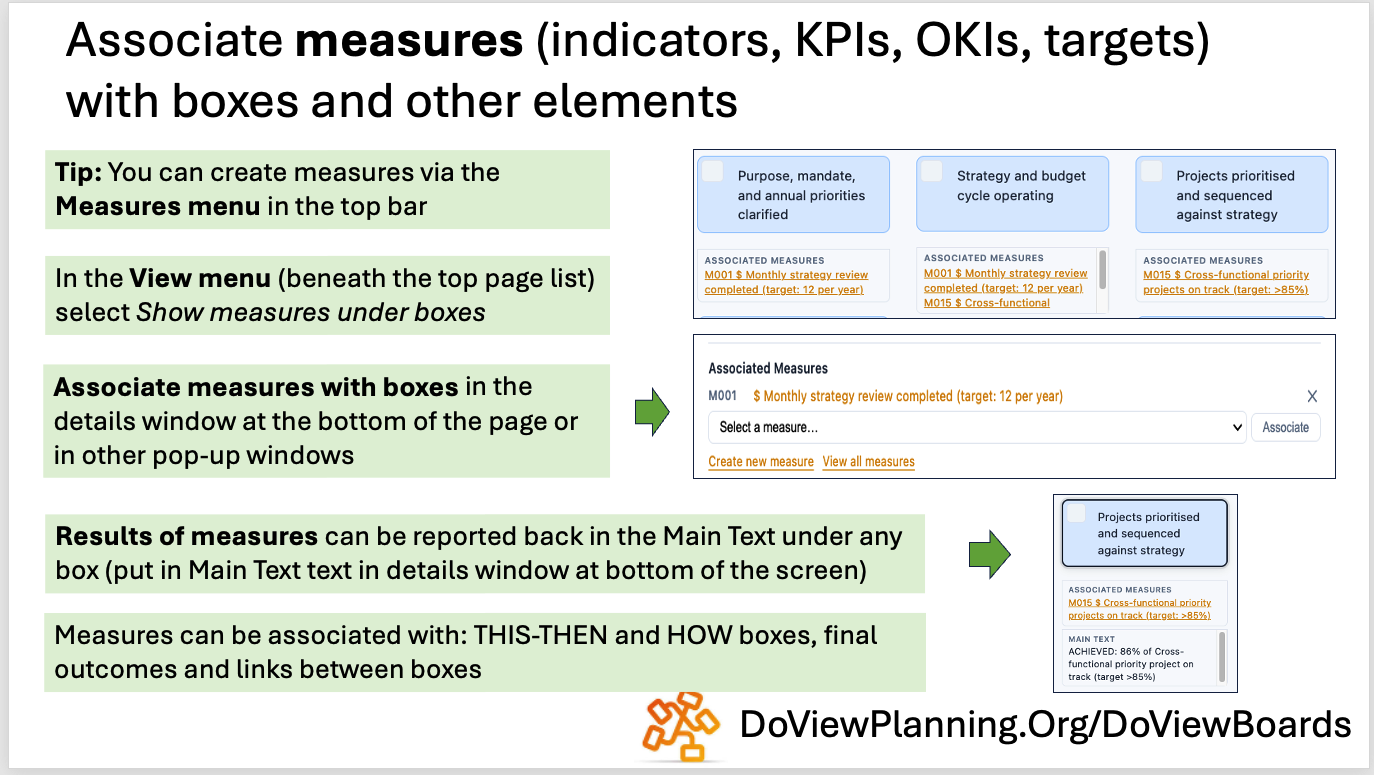
Attach measures, such as metrics, indicators, KPIs and OKRs, under the boxes, links and How elements they actually measure.
Turn them on in the Page View menu to see them on the board, or open the full list from the Measures item in the top bar.
The same measure can sit under more than one This-Then or How box and can be associated with links.
Measurement should follow strategy. With measures mapped onto the model, you can see what they are really telling you, instead of just tracking whatever is easy to count.
Walkthrough where this is illustrated
The video below will start at the relevant section.
16. How are answers to evaluation questions being shown?
What evaluation questions are being answered, and how are implementation and impact evaluation results being shown?
What evaluation questions are being answered, and how are implementation and impact evaluation results being shown?
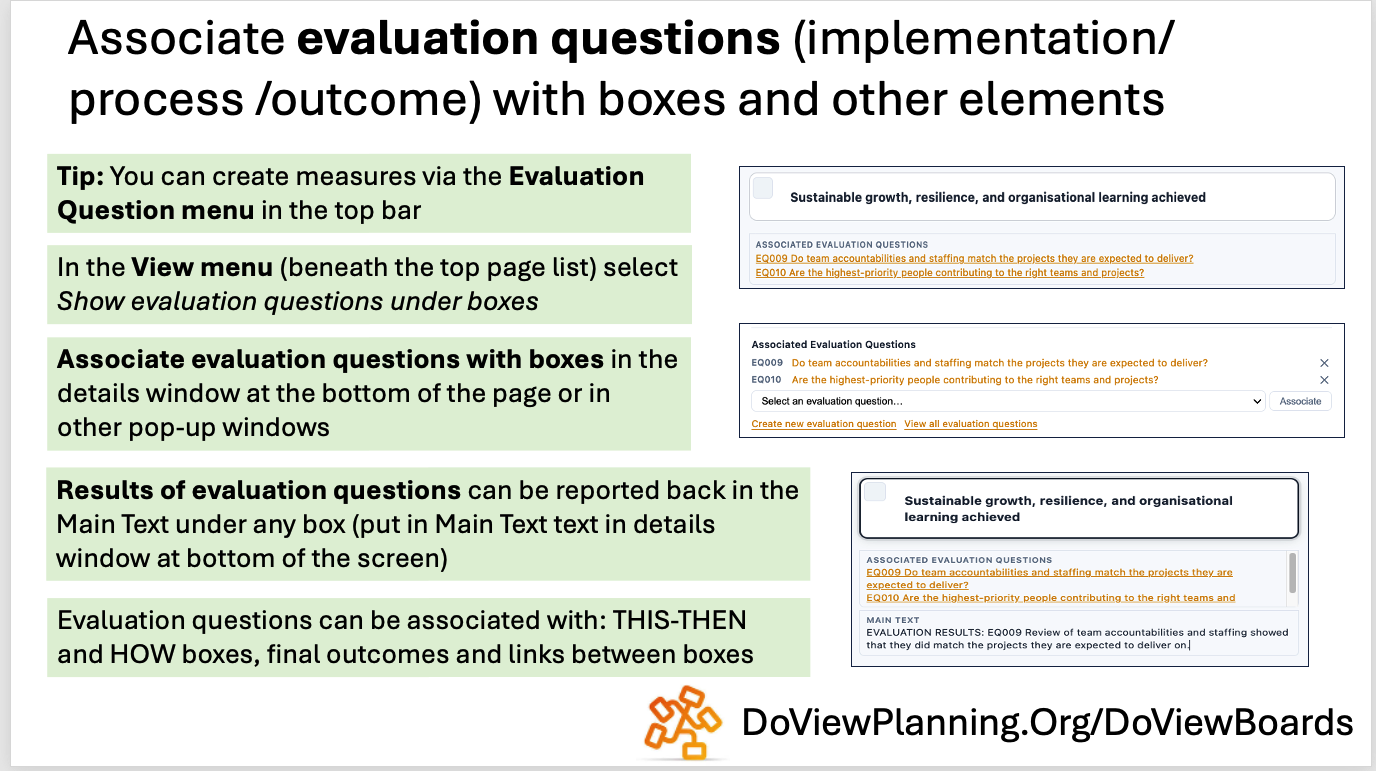
Put evaluation questions under the steps and outcomes they examine. They can be associated with This-Then and How boxes and also links.
Turn them on in Page View, or open the full list from the Evaluation Questions item in the top bar.
The same question can sit under more than one box.
Mapping each question onto the box it examines shows the level an evaluation is really working at, and reveals when two differently worded questions are asking the same thing.
Walkthrough where this is illustrated
The video below will start at the relevant section.
17. How is delivery being improved?
How is ongoing implementation of the work being improved as it progresses?
How is ongoing implementation of the work being improved as it progresses?
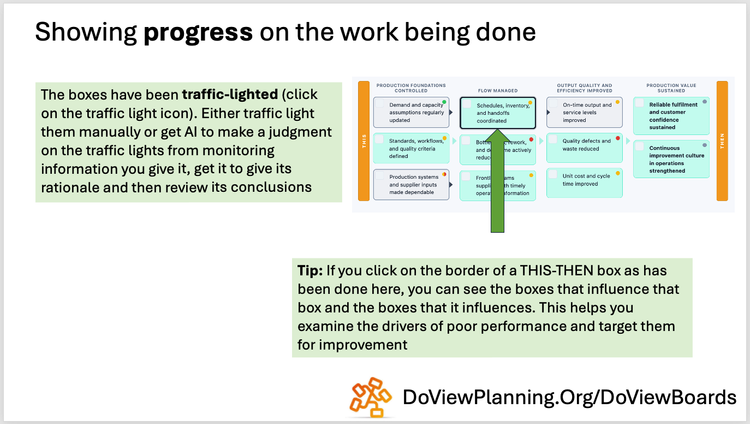
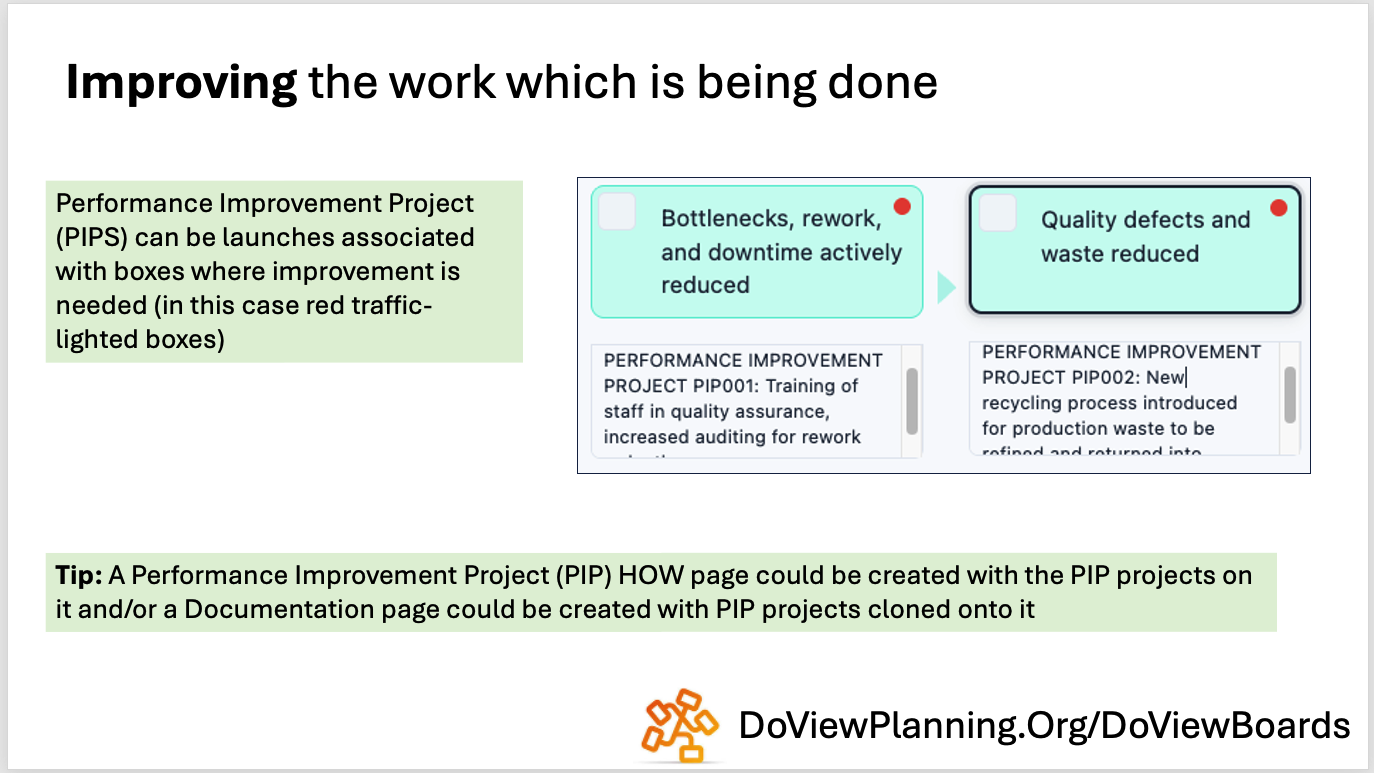
Traffic-light how much progress is being made on boxes across the board.
AI can draft these traffic lights from dashboards, reports and evaluations for you to check.
Hold improvement discussions against the traffic-lit board and decide what to do next.
All the information needed to improve the work is one click away on the board, rather than relying on people remembering what was in various reports.
Walkthrough where this is illustrated
The video below will start at the relevant section.
18. How are results being reported?
How is what is being done, its results and impacts being comprehensively reported back to relevant parties?
How is what is being done, its impact and results being comprehensively reported back to relevant parties?
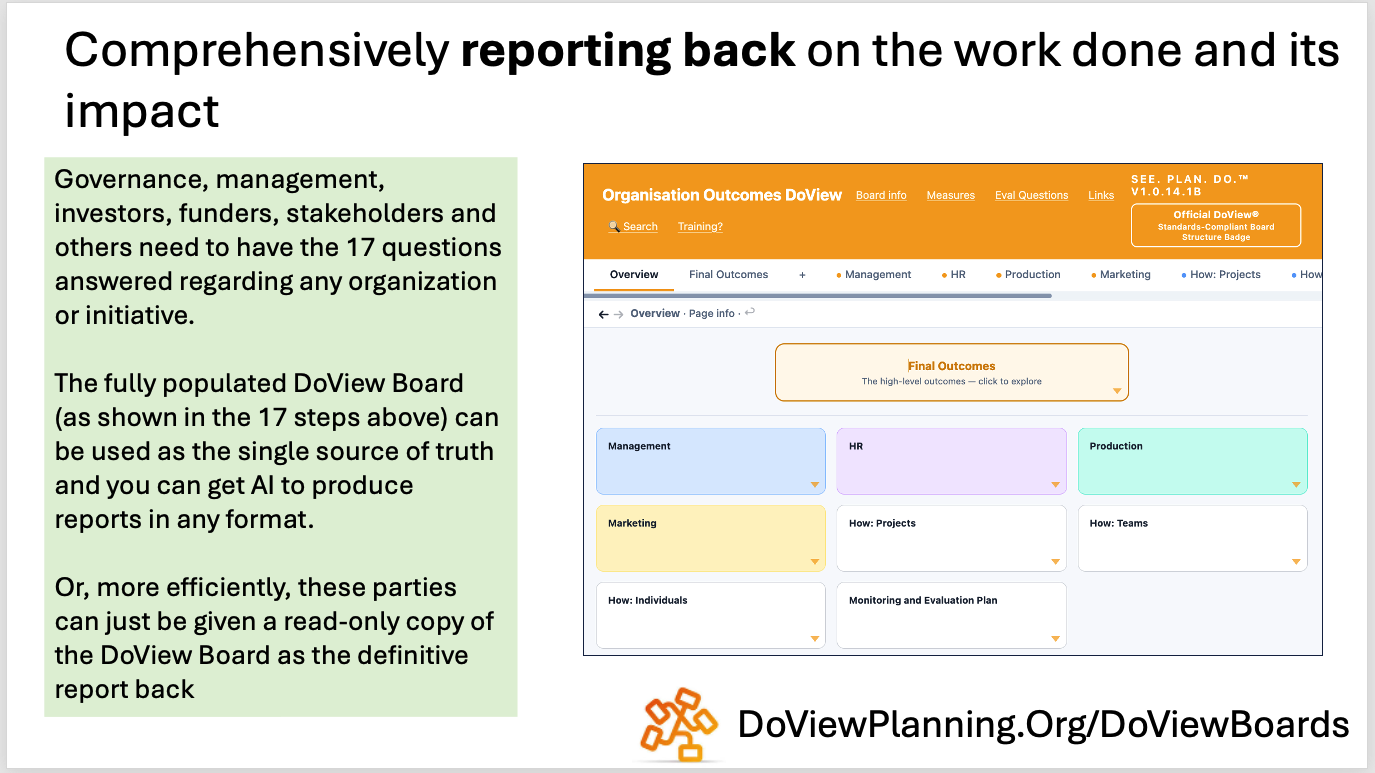
Use the board to report back to governance, management, funders, staff and stakeholders.
If reports are also needed in other formats, have AI produce them from the board as the single source of truth.
Reporting from one board removes a lot of duplication. Once people learn to read a board, they get a fuller picture than traditional reports give.
Walkthrough where this is illustrated
The video below will start at the relevant section.
19. How is knowledge management being handled?
How is knowledge and information about the initiative being handed on to others if staff or those delivering the work change?
How is knowledge and information about the initiative being handed on to others if staff or those delivering the work change?
Keep the board as the authoritative place where the key information about the work is held.
When staff change, or when part of the work is handed to another group, give them the board to come up to speed quickly.
Review the board regularly so it stays a living, current record.
Much of what an organization knows about its work sits in scattered documents and in people's heads. A board keeps it in one place that can be handed on.
Walkthrough where this is illustrated
The video below will start at the relevant section.
20. How is the work being sustained?
How is the work being sustained, scaled, embedded, handed over to others or ultimately exited?
How is the work being sustained, scaled, embedded, handed over to others, or ultimately exited?
Use the board as the single source of truth, and the system of record, for the work over time.
Use it as the authoritative source for AI to produce whatever documentation governance, management, funders or stakeholders require.
Over time, offer those you report to a read-only board as the centrepiece of your reporting.
Build This-Then pages and develop How page projects that are specifically focused on sustainability of the organization or initiative.
Today the answers to these 20 questions are usually scattered across many documents. The aim of DoView Planning is that every initiative has one board that answers them, and that carries the work as it is sustained, scaled, handed over or exited.
Walkthrough where this is illustrated
The video below will start at the relevant section.